第四课 · Leçon IV · Lesson 4

服饰与礼制的宇宙观

Vêtements, Rites et Ordre Cosmique
Clothing, Ritual & the Cosmic Order
核心文字 · Caractères
衣 · 裳 · 冠 · 巾 · 丝
主线 · Fil directeur · Thread
礼制表达 → 形制演变 → 外交媒介
Rite → Form → Diplomacy
第四课 · Leçon IV导览 · Plan

本课路线图 · Plan du cours
Le vêtement comme miroir de la société

第一部分 · Partie 1

起源与形制哲学
Origines & Philosophie

「上衣下裳」的起源与宇宙观。汉服的形制密码(交领右衽、宽袍大袖)、内外层次与冠履制度。
Le système "Haut-Bas", la symbolique du col croisé à droite, les coiffes et la morale confucéenne.
Why does garment structure mirror the cosmos? How did collar direction encode life vs death, civilisation vs barbarism?

第二部分 · Partie 2

阶级与历史流替
Hiérarchie & Évolution

丝麻之辨、五行颜色与尊卑。从先秦严谨到唐代开放,再到宋代理学内敛,直至满清与民国的演变。
L'évolution historique: la couleur Jaune impériale, de l'ouverture au repli néo-confucéen, l'impact nomade.
From Qin austerity to Tang cosmopolitanism to Qing-imposed Manchu dress — how politics shaped every hemline.

第三部分 · Partie 3

丝路与外交媒介
Diplomatie par la Soie

服装作为朝贡体系的软实力符号。赐服制度与汉法文化由于身心观念产生的穿衣区别。
La Route de la Soie, le soft-power du vêtement tributaire, et les différences fondamentales avec la mode occidentale.
Silk as global currency. Imperial dress as diplomatic instrument. Why Chinese robes hid the body while European corsets displayed it.

文明秩序 · Ordre civilisateur1

「上衣下裳」与治国之道
Le vêtement comme reflet cosmique

中国服饰不仅是蔽体之物,更是「礼」 (Rites) 的核心载体。古人认为服饰形制源于对天地自然秩序的模仿。

黄帝、尧、舜垂衣裳而天下治,盖取诸乾坤。
——《易经·系辞》(Le Livre des Mutations) : L'Empereur Jaune laissa pendre ses vêtements, et le monde fut gouverné dans la paix, s'inspirant du Ciel (Qian) et de la Terre (Kun).

— Book of Changes: “The Yellow Emperor let his robes hang, and all under Heaven was governed.” Correct dress was correct governance.

无为而治与乾坤结构 · Non-agir et structure Ciel/Terre

「垂衣裳」象征秩序确立后君王的「无为而治」。「衣」代表天(乾),「裳」(裙)代表地(坤)。衣服必须界限分明,象征社会上下尊卑的不可僭越。
Le haut (Yi) symbolise le Ciel, le bas (Shang) la Terre. Le respect vestimentaire garantit l'harmonie sociale et l'autorité morale (le « non-agir » taoïste au service des rites confucéens).
衣 (upper garment) = Heaven (乾/Qián); 裳 (lower skirt) = Earth (坤/Kūn). Keeping the boundary sharp between upper and lower enacted cosmic order in daily life. In this system, dressing correctly was a political and spiritual act — not mere propriety.

字源:衣与裳 · Étymologie
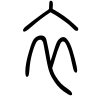
衣 衣甲骨文

yī · Vêtement (Haut)

甲骨文像人穿的上衣,具有交领和敞开的袍袖。
Représente un haut avec un col croisé et des manches tombantes.
衣 is the semantic root of 100+ clothing characters (袍、裳、裙、裤、袖…). Its oracle-bone form literally is a garment with crossed lapels — the character enacts its own meaning.
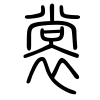
裳

shang · Jupe (Bas)

下半身为裙。古人无论男女,下半身皆穿裙装(裳)。
La partie inférieure du corps. Dans l'Antiquité, hommes et femmes portaient des jupes — le pantalon est une invention nomade.
In ancient China both men and women wore skirt-like lower garments. Trousers (裤) were a nomadic innovation adopted only in the Warring States period (4th c. BCE) by King Wuling of Zhao to make cavalry warfare possible — the reform known as 「胡服骑射」.
形制密码 · Structure du Hanfu2

汉服的经典特征
Les codes esthétiques du vêtement Han

① 交领右衽 · Col croisé vers la droite

汉服衣襟相交,左襟压在右襟之上,呈「y」字形,称「右衽」。右衽代表生者、中原与正统(阳)。只有死者下葬或游牧民族(胡服便于骑射)才会使用「左衽」。
Le pan gauche couvre le pan droit (Youren). La droite est le côté de la vie (Yang) et de la civilisation Han. Le col inversé était réservé aux défunts ou aux peuples nomades.
Right overlap (右衽 yòurèn) = life, civilisation, the Han world (Yang). Left overlap (左衽 zuǒrèn) = death, the dead, nomadic peoples. Confucius wrote: "If Guan Zhong had not served Duke Huan, we would all be folding our garments to the left" — dress was the very boundary between civilisation and barbarism.

② 宽袍大袖 · Manches larges et amples

象征中国思想中道家的「天人合一」与自由洒脱,以及儒家的「端庄大方」。大袖中常缝制有暗袋(袖兜)用于装拾物品。走动时衣袂飘飘,最具古典美。
Manches immenses symbolisant la majesté confucéenne, la liberté taoïste et la fusion avec la nature.
Wide sleeves embody two philosophical ideals at once: Confucian dignity (expansive presence commands reverence) and Taoist naturalness (fabric flowing like water, merging the body with its surroundings). The hidden inner sleeve-pocket (袖兜) also had a practical function — storing objects during slow ceremonial walks without disturbing the silhouette.

穿衣层次 · Les Trois couches

1

内衣 (小衣) · Sous-vêtement

贴身穿着,通常为抹胸或贴身麻布汗衫。
Sous-vêtement de soie ou lin, porté à même la peau.
Closest-to-skin layer; rarely visible but essential for comfort and hygiene. Often a breast band (抹胸) or thin hemp undershirt.

2

中衣 · Vêtement de transition

多为素白色,主要为防止外衣弄脏,相当于衬衣。
Chemise blanche intermédiaire, protège la robe de cérémonie.
Plain white transition layer equivalent to a shirt. Its visible collar edge at the neckline was a public signal of the wearer's cleanliness and refinement.

3

大衣 (外衣) · Robe ou Manteau

展示身份地位的宽大袍服,辅以腰带(带)与配饰(玉佩)。
La robe extérieure de représentation. Sa couleur, ses broderies et ses accessoires (ceinture en jade) signalent le statut social.
The status-display layer: fabric quality (silk vs hemp), colour, embroidery pattern, belt material, and jade pendants (whose sound when walking announced your approach) all encoded rank precisely.
La robe extérieure de représentation : couleur, broderies et pendentifs de jade signalent le statut.
The status-display layer. Fabric quality, colour, embroidery, belt material, and jade pendants all encoded rank precisely. The tinkling sound of jade accessories when walking formally announced your presence.

首服与足衣 · La Tête et les Pieds3

顶戴尊严:冠与巾
Coiffes et Chapeaux

在中国,不戴帽子(免冠)被视为极为失礼。《论语》记述孔子弟子子路战死前,仍坚持“君子死,冠不免”,系好帽带后赴死。「冠礼」是男子的成年礼。

冠

guān

手拿帽子戴在头上。贵族正式头饰。成年礼「冠礼」为男子人生最重要的事件。
Coiffe noble. La cérémonie du "Guan" (coiffure) était le rite de majorité masculin — équivalent de la Bar-Mitzvah conférant le statut d'adulte.
The Capping Ceremony (冠礼 guānlǐ) marked male adulthood: the young man received three progressively grander caps in succession, and was given his courtesy name (字 zì). Bare-headed adults were considered as shamed as bare-footed ones.

巾

jīn

佩在腰间或包头的布。平民或文人日常头饰。各朝属库不同,如东庝巾、宋代东店巾。
Tissu/Félé porté en turban ou ceinture. Usage roturier et lettré. Chaque époque avait ses styles propres.
The humble cloth headwrap worn by scholars and commoners — distinct from the noble 冠. The style of one's 巾 identified literary or political affiliation: the folded 東坡巾 (Su Dongpo's style) signalled Neo-Confucian sensibilities.

帛

顶级丝织物。古代重要财富与书写载体。ぼ为正式文书和外交礼物。
Soierie fine, utilisée comme monnaie, support d’écriture et cadeau diplomatique de premier rang.
Silk (帛 bó) was so valuable it served as a medium of exchange, tax payment, and diplomatic gift. Many pre-paper texts were written on silk scrolls — making 帛 one of the earliest writing surfaces alongside oracle bones and bamboo strips.

鞋履的玄机:翘头履 · Chaussures

承托长裙的翘头

古人穿着长及拖地的衣裳,为了避免踩到裙摆跌倒,汉族传统的鞋子(履)前端多高高翘起(翘头履)。
而且,这象征着「步步高升」的美好寓意与对上天的敬畏。靴(Xue)本是游牧民族用于骑马的服饰,后传入中原成为官服标志。

Les chaussures Han (Lü) arboraient souvent une pointe fortement recourbée vers le haut. Cela évitait de trébucher sur ses longues robes lors des rites de cour et offrait la métaphore de « toujours s'élever ». Les bottes (Xuē) ont des origines nomades.
The turned-up toe (翹头履) had two functions: practical (prevent tripping on floor-length robes during slow ceremonial walks) and symbolic (「步步高升」 — “rise step by step”). Boots (靴 xuē) entered Chinese culture via steppe cavalry riders; they signalled martial service rather than civil virtue.

字形深析 · Caractères en profondeur · Character Deep-Dive3b

服饰核心字 — 从图像到秩序
Du dessin à la morale · From Pictograph to Social Code

衣 oracle
yī · Garment · Vêtement

甲骨文:衣领交叠之形,即上衣本身的形状。
Graphème d'un col croisé — la robe elle-même.
The character IS a garment with crossed collar and open sleeves. 衣 is the semantic root of 100+ dress-related characters in Chinese.

冠 oracle
guān · Headcrown · Coiffe

手将帽子戴于头上的动作。成年礼「冠礼」即得名于此。
Une main pose la coiffe sur une tête. Le rite de majorité masculin (冠礼) tire son nom de ce geste.
A hand placing a cap on a head. The Capping Ceremony (冠礼) was the single most important male rite of passage — receiving the cap meant receiving adulthood and moral responsibility.

丝 oracle
sī · Silk Thread · Soie

两捆缠绕蚕丝之形。丝(糸)偏旁是经济与文明概念的词根:线、织、绸、经、纪、红……
Deux faisceaux de fils tressés. Le radical soie (糸) est racine de : tissu, économie, discipline, rouge…
Two bundles of twisted silk thread. The silk radical (糸) generates: 线 thread, 织 weave, 绸 silk, 经 canon/warp, 纪 record, 红 red — civilisation itself conceptualised through weaving.

字族思维 · Famille de caractères · Character Families: 衣族 → 袍裳裙裤袖袈裟衩衬  ·  糸族 → 丝线织绸经纪红绿紫综  ·  冠族 → 帽帛巾幂幕帷
Chaque radical génère une famille sémantique entière. Apprendre un radical = décoder des dizaines de caractères d'un coup. Each radical generates an entire semantic family. Learning one radical unlocks dozens of characters simultaneously — the key to efficient Chinese character acquisition.
材质的社会学 · Sociologie des matières4

丝麻之辨:阶级的物质化
Soie vs Chanvre : Le mur des classes

在古代,你穿什么材质,直接决定了你的社会成分。由于棉花要到宋元时期才广泛普及,此前的材质有着极其分明的鸿沟。

丝绸 (Soie) —— 贵族与奢侈品

中国是世界上最早养蚕缫丝的国家。丝绸光泽华丽,冬暖夏凉,是王公贵族的专利。普通百姓在某些朝代甚至被法律严禁穿着丝绸(即使买得起)。
Monopole impérial et aristocratique. Le luxe absolu justifié par la loi.
China held the global silk monopoly for nearly 3,000 years — revealing the secret was punishable by death. Silk served as tax currency, diplomatic gift, and writing surface. Sumptuary laws legally banned commoners from wearing it even if they could afford it: the hierarchy was literally sewn into fabric.

麻布 (Chanvre) —— 平民与「布衣」

普通百姓只能穿粗糙刺人的麻(或葛)。因此,古代常用「布衣」这个词来代指平民百姓(如“臣本布衣”)。
Le chanvre rugueux habillait le peuple, d'où le synonyme "Buyi" (vêtement de toile) pour désigner les roturiers.
The phrase 「臣本布衣」 (I was originally a man of plain cloth) became the standard humble self-introduction for a commoner. Cotton (棉 mián) did not reach widespread use until the Song-Yuan transition (13th c.), after which it gradually displaced hemp as the fabric of the people.

字源:财富的象征

丝

sī · Soie

甲骨文形似两捆缠绕在一起的蚕丝。在古代,丝绸不仅是奢华衣物,更可以直接作为等价货币流通和纳税。

Graphème de deux faisceaux de fils de soie tressés. La soie était si précieuse qu'elle servait de monnaie d'échange officielle et de moyen de paiement des impôts.
: two bundles of twisted silk thread. The silk radical (糸) is the root of: 线 (thread), 织 (weave), 绸 (silk), 经 (canon/warp), 纪 (record/discipline) — civilisation itself conceived through textile metaphors. Rome's obsession with Chinese silk created history's first intercontinental trade network.

色彩政治 · Politique des couleurs5

黄色的无上皇权
Les couleurs et les Cinq Éléments (Wuxing)

中国古代色彩不是随意的审美,而是严格根据阴阳阴阳「五行」理论确立的政治礼法(黑=水,红=火,青=木,白=金,黄=土)。
The Five Phases mapped colours onto cosmic forces: Black (Water/North), Red (Fire/South), Green-blue (Wood/East), White (Metal/West), Yellow (Earth/Centre). Each dynasty chose its colour by phase-victory logic: Qin = Black (Water overcomes Zhou's Fire), Han = Red (Fire overcomes Qin's Water). Yellow became supreme only from Sui/Tang onward as the colour of the central Earth.

皇帝为何穿「黄袍」?

秦朝尚黑(水德),汉朝尚红(火德)。但从隋唐开始,基于大地属土、土居中央的传统哲学,黄色被确立为皇帝专属的颜色。
在唐代,平民百姓(甚至官员)若敢私穿黄色衣物即被视为谋反,要杀头。

Sous les Tang, la couleur Jaune (symbole de la Terre, centre de l'univers) devient le monopole exclusif et absolu de l'Empereur. Quiconque portait du jaune risquait la peine de mort pour haute trahison.
Emperor Taizong of Tang codified the yellow monopoly in 627 CE. The legend of Zhao Kuangyin having the yellow robe placed on him in 960 CE to proclaim him emperor of Song shows the colour's undiminished symbolic power centuries later. In Chinese, even today, 「小黄书」 (yellow book) = pornographic content: yellow retains its aura of imperial transgression.

礼服与常服 · Rituel vs Quotidien

礼服 (Li Fu) · Vêtement rituel

用于祭祀、朝会极度繁复的服装(如冕服)。强调僵硬、宽大以压抑肢体动作,确保举止庄重、符合儒家法度。
Tenue formelle/cérémonielle. Extrêmement ample et encombrante pour restreindre les mouvements et imposer une posture hiératique et morale.
The supreme ritual robe (冕服 Miănfú) featured the Twelve Ornaments (十二章纹): sun, moon, stars, mountains, dragons, pheasants, bronze cups, aquatic grass, flame, rice, axe, and the 弗 sign. Each was a cosmological symbol. Wearing the Mianfu was a ritual performance of governing the universe itself.

常服 (Chang Fu) · Vêtement usuel

日常居家或办公的衣服。相对束身便利(如圆领袍)。官僚阶层依据九品官阶,以常服的颜色区分大小(如紫、绯、绿、青)。
Tenue quotidienne/bureaucratique. Plus pratique, les couleurs (violet, rouge, vert) distinguaient le rang des fonctionnaires officiels.
Nine-rank colour system: 1st–2nd rank purple (紫), 3rd–4th crimson (绯), 5th–7th green (绿), 8th–9th blue (青). When Tang poet Bai Juyi wrote "a junior official in green," readers immediately knew the character's exact social rank. Colour was a social information system worn on the body.

朝代风貌 · Évolution Historique I6

历史长河:从庄重到开放
De la sévérité Qin/Han au cosmopolitisme Tang

先秦与汉代 · Antiquité et Dynastie Han
深衣制与礼法确立 · Instauration des rites

服饰严格遵循周礼。典型款式为「深衣」:上衣与下裳缝合在一起(隐藏身体),交领右衽,宽袍大袖。展现古人内敛、端庄的精神风貌。
La robe "Shenyi" (le haut et le bas cousus ensemble). On cache le bas du corps au nom de la pudeur confucéenne.
The 深衣 shēnyī (deep-robe) was the Han dynasty's universal formal garment: upper and lower sections sewn together to create an unbroken line that prevented any glimpse of the body. Its crossed collar, right overlap, and floor-length hem became the template that all subsequent dynasties referenced or rejected.

魏晋南北朝至隋唐 · Dynasties Wei/Jin à Sui/Tang
胡服骑射与盛唐奔放 · Fusions nomades et ouverture

经历了动荡与民族大融合。赵武灵王推行「胡服骑射」,中原引入裤子、窄袖和靴子以利于军事。
到了唐代盛世(L'âge d'or),帝国极度自信,女性服饰空前开放,出现低胸(袒胸装)、半臂,甚至女扮男装穿胡服,受波斯及中亚风格影响巨大。
L'adoption des vêtements nomades (pantalons, petites manches) pour la guerre. Sous les Tang, apogée cosmopolite : les femmes osent des décolletés audacieux et s'habillent en hommes/nomades (influences persanes/turques).
Tang dynasty (618–907 CE) fashion was genuinely cosmopolitan: low-cut bodices (袒胸装), half-sleeves (半臂), Persian-influenced floral patterns, Central Asian horse-riding outfits worn by women. The poet Du Fu wrote of women wearing "translucent gauze in spring." This openness reflected the Tang's confident international identity — and vanished entirely under Song Neo-Confucian moralism.

朝代风貌 · Évolution Historique II7

理学的内敛
Le retour à la rigidité (Song/Ming)

宋明时期:存天理,灭人欲

随着宋代程朱理学(Néo-Confucianisme)的兴起,哲学转向禁欲与内省。唐代的华艳轻挑被抛弃,宋代服饰变得瘦、长、直、淡雅。女性开始被要求缠足(三寸金莲)。
明代推翻蒙古统治后,全面恢复汉族衣冠(飞鱼服、乌纱帽),服饰再次成为极度严苛的政治控制工具。
Le Néo-Confucianisme impose une mode étroite, droite et austère. Disparition du décolleté Tang. Début de la terrible pratique des pieds bandés pour contraindre la femme.
Song Neo-Confucianism (程朱理学) held that the body must be disciplined to cultivate the mind: loose Tang fabrics became narrow and sober. The Ming restoration after Mongol rule (1368) legislated Han dress as a political statement of ethnic identity — the most explicit use of clothing as ethnic-nationalist ideology in Chinese history. The Jinyiwei (锦衣卫 imperial guards) wore the distinctive 飞鱼服 as a deliberate symbol of imperial surveillance power.

满清与近代巨变
Choc Mandchou et modernité

清朝剃发易服与民国旗袍

满清入关,以死刑强制汉人「剃发易服」,终结了数千年的宽袍大袖。清代服饰特点是立领、盘扣、紧身马蹄袖,带有强烈骑射基因。
到了民国(20世纪初),满族旗服与西方立体剪裁结合,诞生了展现女性曲线美的「旗袍」 (Qipao),标志着中国服饰步入现代。
Les Mandchous imposent la natte et la tunique serrée à boutons (fin des manches larges Han). Sous la République, la fusion avec la coupe 3D occidentale donne naissance au Qipao moderne, révélant la silhouette féminine.
The Manchu edict of 1645 ordered Han men to shave their foreheads and adopt the queue braid (辫子) on pain of death — known as 剃发令. Refusing the haircut became an act of political resistance. The modern Qipao (旗袍) emerged in 1920s Shanghai: Manchu banner-robe structure + Western 3D tailoring + Art Deco aesthetics = a hybrid garment that became the global symbol of Chinese feminine elegance.

丝绸之路 · La Route de la Soie8

服饰作为绝对外交媒介
Le vêtement comme soft-power diplomatique

中国古代以「衣冠文献之国」自居(华夏的“华”本意即美丽的服饰)。在传统的朝贡体系 (Système tributaire) 中,服饰是最重要的高级外交工具。

赐服制度 · Le don de vêtements

皇帝向附属国国王和使臣赏赐中国高级丝绸与冠服。周边国家(如朝鲜、越南、琉球)全面吸收并模仿中国汉服(主要为明朝款式),借此宣告自己纳入了以中国为中心的“文明世界(汉字文化圈)”规则中。
L'Empereur "offrait" des tenues impériales aux rois vassaux (Corée, Vietnam, Ryukyu). Adopter le code vestimentaire chinois signifiait l'intégration au monde "civilisé" centré sur l'Empire du Milieu.
The Tributary System (朝贡制度) was China's alternative to Western-style military imperialism: vassal states sent tribute missions and received silk, porcelain, and official investiture in return. Accepting Chinese dress codes was a formal act of joining the Sinocentric world-order. Korea's Joseon dynasty adopted Ming court dress so completely that their officials wore Chinese-style robes for 500 years.

丝绸之路五大节点 · Cinq étapes clés · Five Nodes of the Silk Road

长安》洛阳
Chang'an/Luoyang

丝绸之路起点。丝绸、璷器、茶叶和纸张世界的丝绸之路之旅。
Point de départ : soie, porcelaine, thé et papier quittaient l'Empire du Milieu.

敤马尔罕
Samarkand

类似江湖的中亚商业中海。累施拉皮人(粵特人)成为东西商业连接的中间人。
Pivot commercial en Asie centrale. Les marchands Sogdiens (استیا centrale) contrôlaient les échanges.
Samarkand was the world's great crossroads: Chinese silk westward, Roman glass eastward, Indian spices northward. Sogdian merchants were the FedEx of the ancient world.

安息
Antioche / Rome

罗马元老院议员老普林尼将丝绸资金外流定为「國耐」,年费达一亿西丹迯。罗马贵族女性将丝绸语为超级奇貋恩典。
Pline l'Ancien dénoncaçait l'obsession romaine pour la soie — qui dégarnít les coffres de l'Empire (100 millions de sesterces/an).
Roman women wore transparent Chinese silk gauze — considered scandalously revealing. Emperor Tiberius tried to ban it. The secret of silk-making (silkworms, not plants) was stolen by Byzantine monks c. 552 CE, ending China's monopoly.

马赛论海路
Route maritime

明代郑和七下西洋将丝绸运到非洲东海岸,开辟了连接中起来的「海上丝绸之路」。
Zheng He (1405–1433) : 7 expéditions, 317 navires, côtes africaines atteintes avec soie et porcelaine.
Zheng He's voyages (1405–33) brought Chinese silk, porcelain, and diplomatic missions to Southeast Asia, India, Arabia, and East Africa — long before Vasco da Gama reached India in 1498.

核心概念 · Concepts clés · Key Concepts9b

本课关键概念词汇
Glossaire trilingue · Trilingual Glossary

服饰哲学 · Philosophie
上衣下裳 shāngyī xiàshăng
上衣=天(乾),下裳=地(坤)。穿衣即模仿天地秩序。
Haut=Ciel, bas=Terre. S'habiller = reproduire l'ordre cosmique.
Upper garment = Heaven, lower skirt = Earth. Dressing = enacting cosmic order.
右衩 yòurèn
左襟压右,代表生者、汉族文明与正统。左衩为死者或游牧。
Pan gauche sur droit = vivants, civilisation Han. Inversé = morts/nomades.
Right overlap = life and Han civilisation. Left overlap = death or nomadic peoples.
冠礼 guānlǐ
男子成年礼,为乃为字。尊帺即礼仪。
Rite de coiffure masculine — équivalent de la Bar-Mitzvah. Le jeune homme reçoit son nom de courtesy.
Male coming-of-age rite: receiving three caps and a courtesy name, marking adulthood.
材质与颜色 · Matière & Couleur
布衣 bùyī
麻布衣着之人,即平民的代称。如诸葛亮「臣本布衣」。
« Homme de toile » = roturier. Chanvre = tissu du peuple.
"Man of plain cloth" = commoner. Hemp was the fabric of the people until cotton spread (Song dynasty).
五行五色 wǔxíng wǔsè
黑=水/秦,红=火/汉,黄=土/隆唐+。黄色为天子专属。
Cinq éléments → cinq couleurs. Jaune = Terre = centre = Empereur.
Five Phases colour cosmology: Black(Water)=Qin, Red(Fire)=Han, Yellow(Earth)=Sui/Tang onward — imperial monopoly.
十二章纹 shírsàng zhāngwén
青礼服十二章纹:日、月、星辰、山、龙、华虫、躗廓、粥米、礼确、晚、薻、山躯。
12 ornements de la Robe Impériale : chaque symbole = une dimension de l'ordre cosmique.
Twelve cosmological symbols embroidered on the emperor's ritual robe: sun, moon, stars, mountains, dragons, pheasants, bronze cups, grass, flame, rice, axe, 弗.
历史与外交 · Histoire & Diplomatie
骑射胡服 húsér qísè
战国赵武灵王引入游牧民族的进步系列战争战术,地为汉族服饰引入裤子和靴子的重要改革。
Le roi Wuling de Zhao adopta les vêtements nomades pour la cavalerie — introduisant le pantalon en Chine centrale.
King Wuling's Warring States cavalry reform introduced trousers (裤) and boots (靴) to Han China — the first great nomadic fashion import.
赐服制度 cì fú zhìdù
皇帝赐给藩属国中国丝绸与兆服,接受即表示加入汉字文化圈。
L'Emp. offre des robes aux rois vassaux : accepter = adhérer au monde sino-centré.
Imperial gift of dress to vassal kings = diplomatic incorporation into the Sinocentric world. Korea wore Ming court dress for 500 years.
旗袍 / 旗袍 Qípáo
清代旗服 + 西方立体裁剪 + 民国海派 = 现代旗袍。全球化的女性内镞符号。
Robe mandchoue + coupe 3D occidentale + Art Déco shanghaïen = le Qipao moderne (années 1920).
Manchu banner robe + Western 3D tailoring + 1920s Shanghai Art Deco = the modern Qipao, China's most globally recognised garment.
衣冠演变 · Évolution du Costume9

各朝复原图
Restaurations historiques par dynastie · Historical Restorations

汉 · Han

深衣 · Robe profonde
Wide sleeves, full-body coverage.
Right-overlap collar. Earth tones.

唐 · Tang

低胸·半臂 · Cosmopolite
Open necklines, Persian motifs.
Peak of international fashion.

宋 · Song

褙子·长衫 · Austérité
Neo-Confucian restraint.
Narrow, sober, dignified.

明 · Ming

汉服复辟 · Restauration Han
Full Han dress restoration.
Elaborate rank emblems (补子).

清 · Qing

满族强制 · Imposition mandchoue
Manchu-style horseshoe cuffs.
Queue braid enforced by death.
注:图片为本地资源,需部署在同一目录结构下显示。Images require local deployment under ../../imgs/  |  Les images nécessitent un déploiement local.
男装演变 · Évolution Masculine10

男装图鉴

Vêtements masculins à travers les âges · Men's Dress through the Dynasties
阅读提示 · Reading guide: 注意颈领型的变化:从汉代「交领」→唐代「圆领」→宋代「直领」→明代「交领复古」→清代「立领」。每次变化都是政治与文化的宣言。
Suivez l'évolution du col : Han (croisé) → Tang (rond, ouvert) → Song (droit, sobre) → Ming (retour croisé) → Qing (col droit mandchou). Chaque changement = rupture politique. Follow the neckline across time: Han crossed collar → Tang round collar (open, cosmopolitan) → Song straight collar (austere) → Ming crossed collar (Han restoration) → Qing standing collar (Manchu imposition). Every collar tells a political story.
战国-曲裾袍
Warring States · Robe spiralée
魏晋-大袖宽衫
Wei-Jin · Robe larges manches
隋唐-圆领袍衫
Sui-Tang · Robe col rond
宋辽金元-襕衫
Song-Yuan · Robe à bordure
清朝-礼帽
Qing · Chapeau cérémoniel
明代-常服
Ming · Tenue quotidienne
明代-幞头
Ming · Coiffe officielle
明代-四方平定巾
Ming · Bonnet carré
明代-六合一统帽
Ming · Bonnet unifié
女装演变 · Évolution Féminine11

女装图鉴

Vêtements féminins à travers les âges · Women's Dress through the Dynasties
阅读提示 · Reading guide: 注意腰线的变化:汉代系腰(中腰)→唐代高腰(胸下束带,突显丰腴之美)→宋代低调内敛→明代中腰回归→清代腰线消失(旗装宽直)→民国旗袍贴身曲线。腰线是女性地位的晴雨表。
Suivez la ceinture (taille) : Han (milieu) → Tang (empire, sous la poitrine = féminité ample valorisée) → Song (sobre, pudique) → Qing (droite, sans taille) → Qipao (retour à la silhouette). La taille = le statut de la femme. Watch the waistline: Han (mid-waist) → Tang (empire waist, high-set celebrating full figures) → Song/Ming (concealed, modest) → Qing banner dress (straight, no waist at all) → Republican Qipao (body-defining curves return). The waistline tracks women's social freedom.
战国-深衣
Warring States · Robe profonde
汉朝-襦裙
Han · Jupe à corsage(留仙裙)
魏晋-深衣
Wei-Jin · Robe longue
隋唐-襦裙/半臂
Sui-Tang · Jupe + demi-manches
隋唐-大袖衫
Tang · Ample robe dorée
宋辽金元-褙子
Song · Gilet long fendu
明代-比甲
Ming · Gilet sans manches
明代-霞帔
Ming · Écharpe de cour brodée
明代-凤冠
Ming · Couronne phénix
明代-袄裙
Ming · Veste et jupe
清朝-百蝶袍
Qing · Robe cent papillons
清朝-坤鞋
Qing · Chaussures féminines
民国-旗袍
République · Qipao moderne
文化镜像 · Miroir franco-chinois12

汉法文化镜像 · Miroirs

🪞 镜像一 · Le Corps : Affirmer vs Cacher

欧洲服饰(尤其法国宫廷与紧身胸衣Corset)倾向于立体裁剪,旨在勾勒、强调并展示人体生殖曲线,带有征服自然的张扬;
中国传统汉服采用平面裁剪(大袍阔袖),追求将人体隐藏在线条之中,强调「身」服从于「心」,呈现含蓄、内敛、天人合一的的儒道道德观。
La mode européenne (corset) sculpte et exhibe le corps anatomique en 3D. Le Hanfu chinois (coupe 2D ample) dissimule la chair pour élever l'esprit et respecter la tempérance morale (harmonie Homme-Nature).
European fashion (corset, fitted doublet) shaped and displayed the anatomical body in 3D — a philosophy of body-as-spectacle, nature to be sculpted. Chinese Hanfu used flat (2D) pattern-cutting and ample dimensions to dissolve the body into flowing line — a philosophy of body-as-vessel, nature to be respected. This difference is not merely aesthetic: it reflects a deep contrast between Western Cartesian dualism (mind masters body) and Chinese body-nature harmony (shen 身 is not inferior to xin 心).

🪞 镜像二 · Mode individuelle vs Ordre Cosmos

路易十四在凡尔赛宫通过极端奢华的时尚(高跟鞋、假发)将其作为展示个人王权与吸引贵族的手段;而中国皇帝的礼服(十二章纹)更像是一套宇宙密码,代表天地五行与道德准则,穿衣即是执行天地法则。
À Versailles, la mode est une arme de flamboyance personnelle et de cour. En Chine impériale, le vêtement officiel est un dogme cosmique immuable dictant l'ordre rituel de l'univers.
At Versailles, Louis XIV weaponised fashion as personal theatre: towering wigs, red-heeled shoes, and ever-changing styles forced the nobility into expensive competition and financial dependency on the court. The Chinese imperial ritual robe (冕服) was the opposite: unchanging, cosmic, impersonal — a uniform encoding the Twelve Ornaments that symbolised Heaven, Earth, and the Five Virtues. One used dress as ego; the other as cosmos.

本课总结 · Résumé

汉服的核心形制是交领右衽与宽袍大袖,承载了阴阳哲学与儒家庄重的礼仪规范 (衣、裳、冠)。
Le Hanfu (col croisé, manches larges) incorpore la philosophie du Yin/Yang et l'étiquette confucéenne.
The Hanfu's crossed collar (交领), right overlap (右衽), wide sleeves (宽袍大袖), and three-layer structure (内衣-中衣-外衣) simultaneously expressed Yin-Yang cosmology, Confucian decorum, and Taoist naturalness — a philosophical system made wearable.

材质(丝麻分化)与颜色(五行确立的明黄色)构筑了封建帝国绝对不可逾越的权力等级金字塔。
La stricte hiérarchie matérielle (soie impériale/chanvre du peuple) et la chromatique politique (Jaune centralisée).
Silk (for aristocrats) vs hemp (for commoners) vs cotton (Song onward, for everyone). Yellow = emperor exclusively. Nine ranks of officials = nine colour codes. The garment was a complete identity document: reading someone's clothes told you their exact social position, political allegiance, and moral standing.

服饰随朝代思想演化(唐代开放、宋代理学内敛),并通过赐服制度在丝绸之路上充当外交霸权。
L'histoire du costume fluctue entre l'ouverture nomade (Tang) et le rigorisme intellectuel (Song/Qing), tout en rayonnant via l'Asie comme symbole de civilisation.
The rhythm of Chinese dress history: Qin (austere black), Han (deep-robe dignity), Tang (cosmopolitan openness), Song/Ming (Neo-Confucian restraint), Qing (imposed Manchu dress), Republican (the hybrid Qipao). Each shift was triggered not by fashion trends but by philosophical or political earthquakes. Chinese clothing history is Chinese political history, worn on the body.