礼仪与社会秩序
本课路线图 · Plan du cours
Le "Li" comme tissu de la civilisation chinoise
“礼”的抽象与五礼体系
从神灵崇拜到儒家的道德规范,五礼体系构建了中国古代的宏大秩序。
Des sacrifices religieux à l'éthique confucéenne : le système des Cinq Rites.How did a shamanic ritual offering become the operating system of Chinese civilisation? Why did Confucius say "overcome yourself and return to ritual"?
日常规矩:见面与饮食
拱手礼、揖让、尊卑秩序与餐桌上的“让”的哲学(八分满与公筷)。
L'étiquette du quotidien : Salutations, prosternations et arts de la table.Why does tea get poured to 70% and wine to 80%? How does the direction of a handclasp signal life or death? The daily physics of ritual propriety.
生命的仪轨:婚丧与成年
及笄与加冠,家族婚嫁观念,以及对“个人真爱 vs 家族责任”的反思。
Les rites de passage : Majorité, mariage et culte des ancêtres. Miroir avec la France.Is a marriage contract between two individuals or two families? What does the ancestral temple have in common with a Catholic church? Love vs Duty — comparing two civilisations' answers.
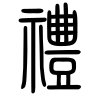
礼 (Lǐ) - Le Rite
象形:在“豆”(容器)中装满两串玉祭祀神明。
Offrande de jade dans un vase pour les dieux.
Oracle bone form: jade vessels (豆 a ritual container) filled with offerings placed before the spirit altar. This is the most archaeologically accurate of all characters for 礼 — a ritual act, not an abstract idea. The secular meaning (social propriety, etiquette) only developed centuries later under Confucius.
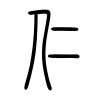
仁 (Rén) - L'Humanité
“人”加上“二”,代表两人之间理想的关系。
Une personne (人) + deux (二) : La relation harmonieuse entre deux êtres.
仁 rén: the character for the supreme Confucian virtue — "benevolence, humaneness, love." Visually: one person + two = a person in relationship. Confucius defined it in over 100 different ways in the Analects, suggesting it was deliberately kept open-ended: 仁 is not a fixed rule but a living orientation toward others.
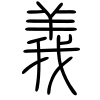
义 (Yì) - La Justice
上“羊”(美善),下“我”(带齿兵器)。捍卫良善的威仪。
Le Mouton (bonté) soutenu par la hallebarde (force morale).
义 yì: righteousness, justice. 羊 (sheep/goodness) on top, 我 (I, originally a toothed weapon) below — goodness backed by moral force. In Confucian ethics: justice is not soft sentiment but the willingness to act rightly even when it costs something. The contrast with Western "justice" (scales, neutrality) is striking: Chinese 义 is active and personal.
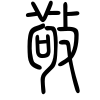
敬 (Jìng) - Le Respect
左侧是“苟”(警惕的狗),右侧是手拿棍棒保持戒备。
Un chien vigilant et une main : l'attitude de précaution et de respect profond.
敬 jìng: respectful attentiveness. Originally depicted a vigilant dog (苟) + a hand holding a rod — the alert posture of someone on guard. In ritual context: 敬 is not passive deference but active, wakeful attention. The Liji specifies that during a ritual, the mind must be 敬 at all times — a kind of mindful presence that prevents any distraction or improper thought.
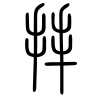
拜 (Bài) - La Prosternation
两手下垂并拢低头之形,表达极度恭敬的姿态。
Deux mains s'abaissant vers le sol, un salut solennel.
拜 bài: to bow, to prostrate, to pay formal respect. Oracle bone: two hands lowering together toward the ground. The full prostration (叩头 kòutóu, "knocking the head") — the ultimate form of 拜 — was required before the emperor, heaven, and one's parents. The Macartney mission's refusal to kowtow before Emperor Qianlong in 1793 became one of history's most consequential acts of etiquette.
从“祀神”到“做人”
Du culte des esprits à l'art d'être humain
在中国古代,“礼”最初是先民向天地鬼神求福的宗教祭祀仪式。随着周朝建立,周公“制礼作乐”,将神圣的祭祀规范转化为人间的政治与社会规范。
À l'origine chamanique (offrandes aux dieux), le "Li" est laïcisé sous les Zhou en un immense système de normes sociales et politiques.
This transformation — from shamanic ritual to social norm — is one of the most significant intellectual moves in world history. The Duke of Zhou's codification of rites (制礼作乐) around 1046 BCE created a secular moral system that would govern Chinese society for 3,000 years. Comparable perhaps to how Roman law transformed from sacred to civil, but in China the transformation was more complete: 礼 replaced religion itself as the basis of social order.
孔子认为,“仁”(内心之爱)必须通过“礼”(外在规范)来表达和约束。礼是文明与野蛮的分界线。
Le "Li" (Rites extérieurs) canalise le "Ren" (Bienveillance intérieure). La politesse n'est pas superficielle, elle est ce qui nous sauve de la barbarie.
This is Confucius's central paradox: 仁 (inner virtue) and 礼 (outer form) are inseparable. Sincerity without form is incomplete; form without sincerity is hypocrisy. The Confucian solution: practise the form consistently and the inner virtue will follow — much as modern psychology shows that acting "as if" you feel an emotion helps produce it. Ritual trains the soul.
中西对比:礼 (Li) vs Lois (Law)
在西方思想史中,社会的最高秩序往往由神法或契约法律 (Contrat social) 来维系。而中国古代维持社会运转的核心是“礼”。
法律是事后的惩罚 (Punition a posteriori),而礼是事前的防范与心理规训 (Prévention et discipline intérieure)。
L'Occident structure la société par la Loi (Rome) et le Contrat. La Chine ancienne se structure par le Rite. La loi punit, le rite prévient en façonnant l'âme.
This contrast was formulated by sociologist Max Weber: Western legal rationalism (law as an external constraint enforced by the state) vs Chinese ritual rationalism (礼 as an internal disposition cultivated from childhood). Modern China's legal system is a hybrid — but the cultural priority of 礼 over 法 (law) remains visible in how conflicts are typically resolved: through mediation, face-saving, and relationship maintenance rather than litigation.
五常与五伦:礼的双层架构
Les Cinq Vertus et les Cinq Relations · The Dual Framework of Ritual
五常是个人内心的排齐。礼就是这五种内心状态在行为上的外在表达。
Les cinq vertus intérieures que le Rite extérioriserait en comportements.
The Five Constants are the inner moral states; 礼 (Ritual) is their external expression. The Confucian theory: practise the form correctly → the inner virtue follows. Like physiotherapy for the soul.
仁 Rén · Bienveillance · Benevolence
L'amour universel, la compassion pour autrui.
The supreme Confucian virtue: active love toward all humans, from which all others flow. The character itself means "a person in relation to two."
义 Yì · Justice · Righteousness
La droiture morale qui acté en faveur du bien.
Righteousness as active moral force — not passive fairness but the willingness to defend the good at personal cost. Sheep (goodness) + weapon (force) = righteousness armed.
礼 Lǐ · Rites · Ritual Propriety
La forme extérieure qui canalise les quatre autres vertus.
礼 is simultaneously a virtue and the system for expressing all virtues. It is both the music and the instrument — the form that makes inner virtue legible to the world.
智 Zhì · Sagesse · Wisdom
La capacité de discernement moral juste.
Practical wisdom — knowing what the right action is in a given situation. Not theoretical knowledge but moral judgement. The wise person knows when to apply which rite.
信 Xìn · Sincérité · Integrity
La cohérence entre les mots et les actes.
Trustworthiness — keeping one's word. The character: person (人) + speech (言) = standing by what you say. Without 信, ritual becomes hollow performance; with it, every gesture carries genuine weight.
五常与五伦:礼的双层架构 (续)
Les Cinq Relations · The Dual Framework of Ritual (Cont.)
五伦是礼在具体社会关系中的应用。五种关系涵盖了一个人的全部礼制运行。
Chaque relation a ses rites spécifiques. Les cinq couvrent toutes les interactions humaines fondamentales.
The Five Relationships define the specific ritual obligations for every fundamental human bond. Together they form a complete social map — there is no important relationship that falls outside this framework.
义 (righteousness) — loyalty and just governance
Le souverain juste; le sujet loyal.
Not unconditional obedience: the ruler owes just governance; the subject owes loyal service. The Mandate of Heaven could be withdrawn from a tyrannical ruler.
慈 + 孝 — kindness and filial piety
La bienveillance du père; la piété filiale du fils.
The father owes kindness (慈 cí); the son owes filial piety (孝 xiào). Both are obligations, not only the son's.
奈 + 添 — harmony and obedience
La douceur du mari; l'écoute de l'épouse.
The most asymmetrical of the five — the wife's 从 (compliance) reflects Confucian gender hierarchy. This was also the most debated relationship in Chinese feminist thought from the late Qing onward.
友 + 恭 — elder care, younger respect
La bienveillance de l'aîné; le respect du cadet.
Sibling hierarchy: the elder (兄) owes 友 (fraternal care); the younger (弟) owes 恭 (deferential respect). This relationship trained children for the ruler/subject dynamic.
信 (integrity) — the only equal relationship among the five
La seule relation entre égaux : fondée sur la confiance mutuelle (信).
The only horizontal relationship in the Five. Friends owe each other 信 (faithfulness) — the virtue of keeping one's word. Confucius valued true friendship highly: "Friends from afar — is that not a joy?" (有朋自远方来,不亦乐乎).
《周礼》:包裹世间万物的分类学
Le système universel des Cinq Rites Maternels
中国古人将人类生活的一切重要活动,精准地划分为系统化的“五礼”。
La vie humaine entière, du culte impérial aux repas, est catégorisée en 5 familles rituelles.
吉礼 (Auspicious Rites / Sacrifices)
等级最高的礼仪。祭祀天神、地祗、人鬼(祖先)。Rites sacrificiels (Ciel, Terre, Ancêtres).
吉礼 (Auspicious Rites) were the pinnacle of the ritual system: elaborate sacrifices to Heaven (天 at the Temple of Heaven 天坛), to Earth (地 at the Altar of Earth 地坛), and to royal ancestors (in the Imperial Ancestral Temple 太庙). The emperor performed these personally — his body was the instrument of cosmic mediation. The Beijing 天坛 (Temple of Heaven, 1420 CE) was built precisely for this purpose and remains one of the world's most architecturally perfect ritual spaces.
凶礼 (Inauspicious Rites / Mourning)
哀悼死亡与灾祸。丧葬、恤荒(赈灾)。Rites funéraires et de deuil. Gestes lors de famines.
凶礼 (Inauspicious Rites) covered mourning and disaster response. The mourning system was extraordinarily detailed: 27 months of mourning for a parent, with specific garments, diet restrictions (no meat, no wine), and behavioral rules for each stage. The state also had ritual obligations during famines — the emperor would perform self-accusatory rites, acknowledging that natural disasters signified his failure of virtue.
宾礼 (Guest Rites / Diplomacy)
诸侯朝见天子,以及国与国之间的外交礼节。Diplomatie, réception d'ambassadeurs et d'hôtes étrangers.
宾礼 (Guest Rites) governed all diplomatic encounters — from the annual tribute missions of vassal states to the reception of foreign ambassadors. The notorious controversy over whether foreign envoys should perform the full kowtow before the Chinese emperor was a 宾礼 dispute: Britain's refusal (Macartney 1793, Amherst 1816) represented not arrogance but an incompatibility between two ritual systems, each claiming universal authority.
《周礼》:包裹世间万物的分类学 (续)
Le système universel des Cinq Rites Maternels (Cont.)
军礼 (Military Rites)
军队出征、凯旋、阅兵、田猎之礼。Rites martiaux : Départs en guerre, triomphes, parades.
军礼 (Military Rites) ritualised warfare itself: divination before departing, specific sacrifices before battle, the formal reception of captives, the announcement of victory to the ancestral temple, and the prescribed treatment of the defeated. War was not purely pragmatic — it was embedded in the same ritual framework as all other social activity. Defeating an enemy required reporting it to Heaven.
嘉礼 (Festive Rites)
亲善和谐。涵盖饮食、婚冠(成年礼)、宾射及节庆。Rites de réjouissance : Mariages, majorité, banquets rituels.
嘉礼 (Festive Rites) were the most socially present of the Five: the Capping Ceremony (冠礼, male coming-of-age), the Hairpin Ceremony (笄礼, female coming-of-age), the Six Wedding Rites (六礼), the archery contests and communal drinking ceremonies that maintained social bonds. These were the rites that ordinary people encountered daily — the ritual infrastructure of communal life.
君子的物理空间:见面与跪拜
Gestion de la distance corporelle : Saluer sans toucher
古代中国人见面避免肢体接触,以维持尊重和界限感(与西方握手、亲吻截然不同)。
Historiquement, la Chine évite le contact physique (poignée de main/bise) pour marquer la sacralité de l'espace personnel.
This is one of the most striking contrasts for French students: French greeting culture (the bise cheek-kiss) literally dissolves the boundary between bodies to signal trust. Chinese greeting culture (拱手, the clasped-hands bow) maintains a respectful physical distance. Neither is more or less "civilised" — they encode opposite theories of how trust is built: through contact (breaking the defensive boundary) vs through restraint (demonstrating self-control).
拱手礼 (Gongshou) - Salutation poings joints
- 男子:右手握拳在内,左手舒展包在外。因左为阳,代表吉善;右为阴,拿武器代表杀气。
Hommes : Main gauche (vie) couvre le poing droit (arme).
The symbolism is precise: the right hand (traditionally the weapon hand) is enclosed by the left (the open, peaceful hand). The gesture says: "I am concealing my weapon-capacity inside my peaceful intention." The reversal at funerals — right enclosing left — signalled the opposite: grief has inverted the normal order of the world. - 女子:与男子相反,右手压左手。
Femmes : Main droite couvre la gauche.
Women reverse the hand positions: right (yang, active) enclosed by left (yin, receptive) — reflecting the yin/yang cosmological polarity applied to gender. This was not arbitrary; every element of ritual form encoded a philosophical statement about the cosmic order. - 凶服 (Deuil) : 参加丧礼时,手势恰好反转。Gestes inversés pour les funérailles.
Ritual inversion at death: everything is reversed — garments overlap the wrong way, gestures mirror the living norm. This marked the deceased as having crossed into a different cosmic register. Meeting a stranger performing the mourning-gesture was an immediate social signal: "this person is in grief, treat them accordingly."
揖让礼 (Yi/Rang) - Le salut silencieux
推手为揖,古代宾主相见的高级礼仪。手随腰向下弯然后再抬起,姿态优雅舒缓。
S'incliner en poussant les mains jointes en avant.
揖让 (yī-ràng): the formal bow with both hands clasped and pushed forward, combined with 让 (yielding, deferring). This composite concept — physical gesture + moral disposition of yielding — captures the Confucian ideal perfectly: the body enacts what the mind practises. The gentleman who 让 in greeting is the same one who 让 in conversation, in eating, and in governance.
跪拜礼 (Guibai) - La Prosternation
最隆重的礼节。体现极其严格的尊卑分明:天子受臣下之拜,父母受晚辈之拜。在古代神权社会,下跪意味着完全的臣服与感激。
Acte solennel réservé à l'Empereur, aux Cieux et aux Parents. Marquait l'humilité absolue dans la hiérarchie verticale confucéenne.
The kowtow (叩头 kòutóu) — forehead to the ground three or nine times — was reserved for the absolute summit of the hierarchy: Heaven, the emperor, and one's parents. It was not humiliation but the highest expression of reverence. The Western misreading of kowtow as "degrading submission" missed the point: in the Confucian framework, the willingness to fully prostrate oneself showed moral greatness, not weakness.
舌尖上的尊卑与“让”
Hiérarchie et Philosophie de la Modération à table
中国的饮食礼仪本质是“社会权力”缩影。
La table chinoise est une miniature de la société politique et familiale.
Chinese dining etiquette is essentially applied political philosophy: who sits where, who eats first, who serves whom — all encode the family and social hierarchy in real time. The circular table (圆桌 yuánzhuō) is not accidental: the circle has no head, suggesting equality — but the position facing the door is still the place of honour. Form and content remain in productive tension.
- 尊长优先 (Aînés d'abord) : 长辈未动筷,晚辈绝不能先食。Les jeunes ne mangent qu'après l'aîné ou l'invité d'honneur.
In traditional Chinese families, children could not begin eating until the eldest family member had started — a visible enactment of 孝 (filial piety) at every meal. This extends to guests: the host serves the honoured guest first (劝膳 quànshàn), physically placing food in their bowl. Refusing a serving is potentially rude; accepting and then serving someone else in return builds the social fabric. - 坐次讲究 (Plan de table royal) : 正对大门或朝东的位置为主座 (尊座)。La place d'honneur fait face à la porte (ou face au sud/est).
The seating map encodes cosmology: facing the door (command of arrivals and departures = authority), facing south (the auspicious direction of yang energy), or facing east (the direction of the rising sun = seniority). In a business dinner today, the hierarchy is still legible in the seating arrangement — knowing the rules tells you who holds real power in the room. - 用公筷 (Baguettes communes) : 合餐制中的卫生与礼貌,为客人夹菜表达热情 (劝膳)。Utilisation de baguettes de service pour l'hygiène et l'hospitalité (servir l'autre).
Public chopsticks (公筷 gōngkuài) serve a dual function: hygienic separation and the ritual act of serving others (劝膳). When a host places the best piece of food into a guest's bowl, the act embodies the Chinese ideal of 让 (yielding, giving precedence). The chopsticks themselves encode a philosophy: two smooth sticks that take from a shared dish without stabbing — communal solidarity built into the tool.
“茶七酒八” 的适度哲学
斟茶七分,斟酒八分。
倒茶太满容易烫手,被视为“赶客”。
倒酒太满则容易溢出。这背后是中国哲学中“满招损,谦受益” (Le trop plein attire la ruine) 的中庸思想。绝不追求极致的盈满,必须留有余地(留白)。
"Thé rempli à 70%, Vin à 80%". The 70%/80% rule for tea and wine is a microcosm of the Chinese philosophy of the Mean (中庸 zhōngyōng): never fill to the brim, always leave room. A cup filled to 100% has no margin for movement — it will spill. The metaphor extends: a life, a relationship, a career pursued to its absolute maximum becomes unstable. The Chinese ideal is always to leave 留白 (empty space) — an echo of the Taoist principle that the useful part of a vessel is its emptiness.
Le thé bouillant versé à ras bord brûle et signale qu'on veut chasser l'invité. Sur le plan philosophique, rechercher le 100% (la plénitude absolue) annonce le déclin. La politesse, c'est laisser de la marge (la Voie du Milieu).
成人之美:告别童年
Acquérir sa liberté en endossant ses devoirs
男子:加冠礼 (Jiā Guān)
古代男子满 20岁(“弱冠”)时举行。宗族长辈会在太庙前,三次为他加盖不同级别、更为庄重的帽子,象征他获得了参军、祭祀、治人的政治权利与道德责任。
The 冠礼 (Capping Ceremony) was the most important ritual in a young man's life — more significant than any birthday. Three caps were placed in succession: a ceremonial black cap (symbolising ritual eligibility), a leather cap (military service), and a skin cap (political authority). At the end, the young man received his 字 (courtesy name) — the name by which all non-family members would address him for the rest of his life. The name chosen typically reflected a Confucian virtue to aspire to.
女子:及笄礼 (Jí Jī)
古代女子满 15岁时举行。将头发盘成发髻,插上簪子(笄)。这标志着她已经成年,可以许配人家、出嫁为人妻子与母亲。
The 笄礼 (Hairpin Ceremony) at 15 for girls was structurally parallel to the 冠礼 for boys. The transition from loose braids (childhood) to a pinned chignon (adulthood) was a public announcement of marriageability. The girl also received a courtesy name. What differs from the male rite: the 冠礼 granted civic rights; the 笄礼 granted the right to marriage and motherhood — a difference that reveals the asymmetry between male and female paths in traditional society.
六礼:两姓合婚的神圣程序
Les six étapes sacrées du mariage traditionnel · The Six Sacred Steps of Traditional Marriage
男方家展刀媒人携带礼物前往女方家提亲。礼物以雁为首(雁为信义之鸟)。
La famille du garçon envoie la marieuse avec des cadeaux (dont une oie, symbole de fidélité) demander la main de la jeune fille.
The first formal approach: the groom's family sends the matchmaker with gifts — led by a wild goose (雁), symbolising seasonal faithfulness. The goose migrates reliably with its partner: a promise of constancy.
媒人代请女方的年庚、生辰年月日,用于占卜共相与其相属(生辰八字。
On demande les "huit caractères" (année, mois, jour, heure de naissance) pour la consultation astrologique de compatibilité.
The bride's "eight characters" (八字 — birth year, month, day, hour in the 60-cycle system) were consulted by a diviner to assess astrological compatibility. An incompatible pairing could doom the marriage before it began.
占卜得吉兆后,男方家展刀媒人将吴吉的占卜结果知会女方家。双方确认婚事。
Si l'oracle est favorable, la marieuse informe la famille de la jeune fille : les fiéancailles sont officiellement confirmées.
The divination result is communicated back to the bride's family. If auspicious, the engagement is formally confirmed — at this point the couple is socially committed, though not yet married.
婚妻的实质同意步骤。男方将聰爲等贵重的定亲礼物送往女方。接受就意味着缔丰婚论。
Le moment décisif : envoi des cadeaux de fiançailles (or, soie, nourriture symbolique). Accepter = contrat officiel.
The pivotal rite: the groom's family sends formal betrothal gifts (silk, gold, ceremonial food). The bride's family accepting these gifts constituted a binding contract — equivalent to signing a modern marriage agreement.
男方请占卜师择定吴吉的婚期,展刀媒人安排女方确认日期。
Un astrologue choisit la date auspicieuse selon le calendrier lunaire. La famille de la jeune fille valide.
The wedding date was not chosen freely: a diviner consulted the lunar calendar and the couples' birth characters to find an auspicious date. An ill-chosen day could bring disaster; the right day multiplied good fortune.
最实质的一步。新郎亲自前往女家,把新娘迎接到为家,合卷饮酒,天地合巹。正式一夫一妻。
Létape culminante : le mari vient personnellement chercher sa future épouse (en char), puis les deux boivent dans la même coupe — union officielle.
The climax: the groom himself comes to escort the bride to his family home. The couple drinks from a shared gourd cup (合卺 héjǐn) — the moment of official union. This shared drinking ceremony is the structural equivalent of Western ring-exchange: the ritual act that seals the marriage.
跨文化对比 · Comparaison : 六礼将婚姻展开为一个长达数月的公共过程而非一个一对山的私事。
Les Six Rites étalent le mariage sur plusieurs mois. Il n'est pas une affaire privée mais une négociation publique entre deux familles.
The Six Rites stretched the marriage process over months or years, making it a public, multi-stage social negotiation rather than a private decision. Compare: a French civil marriage takes minutes; a traditional Chinese marriage took six ritual steps and required community validation at each stage.
婚嫁:两姓之好
Mariage : Alliance sacrée de deux familles
传统婚姻的核心不是个人的浪漫爱情,而是家族利益与延续。程序繁峻(六礼),极其看重“父母之命、媒妁之言”。 (Les ordres des parents et les paroles de l'entremetteuse priment).
Traditional Chinese marriage was a contract between two family lineages (两姓之好), not two individuals. The parents' authority (父母之命) and the matchmaker's mediation (媒妁之言) were legally required — a marriage contracted without them was invalid. This was not arbitrary authoritarianism: the family's survival, property, and ancestral continuity depended on wise marriage choices. The individual's romantic preference was one input among many.
Q: 中国古人有真爱吗?(Y a-t-il un "vrai amour" dans la tradition ?)
古代认为,炽烈的激情(Passion)容易失控毁灭秩序。因此推崇先婚后爱,将“恩”与“义”置于前。
最理想的异性关系是“相敬如宾”(伴侣互相尊重如同贵客)。在责任和长久的陪伴中培育出的温和深情 (Qing/affection),才是真爱。
L'amour passionnel précède le mariage en Occident; en Chine, l'affection (Qing/恩) se cultive à l'intérieur du devoir. Le couple idéal se respecte avec l'élégance due à des invités solennels.
The Chinese concept of ideal love as 相敬如宾 ("respecting each other as honoured guests") is structurally opposite to the Western romantic ideal of passionate fusion. China's literary tradition does celebrate intense romantic love — Tang Xianzu's Peony Pavilion (牡丹亭, 1598), the Dream of Red Mansions — but as a tragic exception, not the norm. The Confucian ideal was a love cultivated within duty, not a passion that preceded it.
家祭:跨越生死的连接
Culte familial et Temple Ancestral
通过祭祀,死亡不是终结而是祖先神格化的开始。子孙在宗庙中供奉牌位,共享祭肉(胙)。
La mort n'est pas une rupture. Le défunt entre au Temple Ancestral où ses descendants le nourrissent et où il les protège.
The ancestral temple (宗庙) was not a place of mourning but of ongoing relationship. The deceased ancestor received regular food offerings, was consulted on important family decisions, and protected the lineage in return. This is the Chinese answer to mortality: death does not sever relationship — it transforms it. Compare with Catholic saints' intercession: the structural logic (the dead protecting the living through ritual) is remarkably parallel.
“Servir les morts et les disparus avec autant de respect que s'ils étaient vivants et présents, voilà la Piété Filiale suprême.”
本课关键词汇 · Mots-clés · Glossary
孔子核心教证:为仁在于克己复礼。
La formule centrale de Confucius : «Surmonter son ego, revenir aux Rites».
"Overcome the self and return to ritual — that is benevolence." The single most quoted line in the Analects: self-mastery through ritual form is the path to 仁.
不偏不倒,有仔无急的中道哲学。
Ni trop ni pas assez : la Voie du Milieu confucéenne.
The Confucian Mean: neither excess nor deficiency. Tea at 70%, wine at 80%, the unhurried bow — all are practical applications of this philosophy. Not mediocrity but dynamic balance.
情感深匿,不直接外露。中国最大的礼仪美学。
L'expression émotionnelle réservée : la beauté de ce qui n'est pas dit.
The aesthetic of emotional restraint — saying more by saying less. 含蓄 is why Chinese poetry relies on image and implication; why Chinese ritual never shouts. Contrast with French éloquence and franchise.
社会声誉与公众形象。不可损害的礼仪资本。
Le "visage" social — réputation et dignité publiques. Capital rituel intouchable.
Social "face": the public reputation and dignity that ritual interaction constantly negotiates. Giving face (给面子), losing face (丢面子), and saving face (留面子) are the operational vocabulary of Chinese social life.
右拳包入左掌。男性。不接触的距离敢意。
Poing droit enfermé dans la main gauche. La paix manifestée par la retenue.
Right fist enclosed in left palm: the weapon hand concealed within the peaceful hand. The greeting that says "I could harm you — but I choose to restrain myself in your honour."
叏头至地三次或九次。天子、父母、神明的礼节。
Front contre le sol (3 ou 9 fois). Réservé à l'Empereur, aux parents et aux dieux.
Forehead to the ground, 3 or 9 times. Not humiliation but the highest gesture of reverence. The Macartney mission's refusal in 1793 embodied the clash of two incompatible ritual systems claiming universal authority.
自愈、谦让、优先考虑他人。礼中的莊心。
L'acte de céder : se mettre en retrait pour l'autre. L'âme du Rite.
The act of yielding: stepping back to give precedence to another. 让 appears in 揖让 (the yielding bow), 谦让 (humble deference), 礼让 (ritual courtesy). The capacity to 让 is the test of genuine ritual internalisation.
对父母、祖先的尊敌。五伦的核心。
Le respect dû aux parents et aux ancêtres. Vertu cardinale irréductible.
Filial piety: the duty of reverence to parents and ancestors. The Chinese Classic of Filial Piety (孝经) ranked it as the root of all virtue. A son who failed in 孝 had failed at everything — politically, socially, morally.
"20岁强冠"—–20岁男子成年的代称。
"L'âge du chapeau faible" : surnom classique des 20 ans masculins.
"The age of the first (weak) cap" — the classic Chinese expression for a 20-year-old man, evoking his Capping Ceremony. The courtesy name received at 冠礼 was used by all non-family members for life.
"女子15岁为及箄之年"——女子成年的代称。
"L'âge de l'épingle" : 15 ans pour les filles (majorité féminine).
"The age of the hairpin" — 15 for girls, marking marriageability. A four-year gap from the male ceremony (20) reflects the different social trajectories: women entered adult life younger and through a different door.
纳采、问名、纳吉、纳征、请期、亲迎。
Six étapes s'étalant sur des mois : demande, horoscope, fiançailles, dot, date, cortège.
Six steps spanning months: initial approach → name/horoscope inquiry → auspicious confirmation → betrothal gifts → date setting → groom's procession. Each step required community witnessing — marriage as public event, not private decision.
【论语》开篇第一句。
Première phrase des Entretiens : "Apprendre et pratiquer — n'est-ce pas une joie ?"
"To learn and practise at the right time — is that not a joy?" The Analects' opening line. Ritual is not a burden but a practice of joyful self-cultivation — Confucius insists on this from the very first sentence.
中西文明的“空间与接触”法则
Distance vs Contact dans la géométrie de la courtoisie
🇫🇷 物理接触与平等信赖
西方礼仪(如握手、法式贴面礼 La Bise、拥抱)本质上是通过“打破物理边界”来展示和平与信赖(“我手中没有武器”,我们可以亲密接触)。
骑士精神 (Chevalerie) 与后来的宫廷礼仪 (Galanterie) 强调对弱者/女性的殷勤侍奉,其表现方式具有高度的表演性、个体性与外放张力。
L'Occident pacifie en brisant l'espace personnel (ex: tendre sa main vide de lame, La Bise). La Galanterie met en scène l'individu dans un jeu social extraverti et d'attention séductionnelle.
🇨🇳 保持距离的敬意之美
中国礼仪(如拱手、作揖)本质上是通过“克制与保持庄严距离”来展示敬畏与秩序。君子的交往是淡如水的。
儒家礼仪并不为了浪漫或表演而存在,而是为了约束个体的欲望,把人安放在家庭/社会的正确网络坐标里(非礼勿动)。在情感表达上尤为内敛(含蓄)。
La Chine pacifie en maintenant une sainte distance (Gongshou). L'eau est la métaphore de l'amitié des nobles : pure et sans passion violente. Le Rite contient l'ego.
法式大餐 (Repas gastronomique) 使用精确复杂的刀叉工具,强调按阶段的个体享受。每个人拥有自己的餐盘,彼此互不侵犯边界。
Service à l'assiette, précision chirurgicale des couverts. L'individualité est sacrée : "mon assiette, ma portion".
The French repas gastronomique (UNESCO 2010) is structured in precise sequential courses, each with dedicated cutlery. The individual portion is sovereign — tasting from someone else's plate is an intimate act requiring permission. This reflects the broader French philosophical tradition of individual rights and private space.
中国的大圆桌和共享菜肴,强调家庭或集体的凝聚力(团圆)。使用公筷夹菜(谦让/奉献),弱化个体的占有界限。
Table ronde, plats partagés. Les baguettes abolissent la frontière individuelle pour faire triompher l'Harmonie collective et la générosité mutuelle.
The Chinese round table with shared dishes makes individual portions impossible — eating is inherently collective. The act of 劝膳 (placing food in someone's bowl) is a physical expression of care. Both Chinese and French gastronomies are UNESCO Intangible Cultural Heritage — but their philosophies of eating encode opposite values: individual pleasure vs collective harmony.
第六课 总结 · Résumé · Summary
"礼"脱胎于甲骨卜辞中的祭祀,被周公与孔子确立为人伦纲常的法则。
Né de l'offrande chamanique, le Rite est laïcisé en norme sociale universelle par le Duc de Zhou et Confucius.
Ritual began as an offering to the gods (jade in a vessel) and became the operating system of Chinese civilisation. No other culture made this secular transformation so completely — or so durably.
拱手礼、茶七分满——皆是对"中庸""不越界"哲学的身体实践。
Le 拱手 et le thé à 70% : chaque geste incarne la modération. Le corps pratique ce que la philosophie prêche.
Tea at 70%, wine at 80%, the clasped-hands bow that keeps its distance — each encodes the Doctrine of the Mean in physical form. Ritual trains the body; the trained body trains the soul.
婚姻并非始于激情,而是终于深刻的家庭道义。相敬如宾,先婚后爱。
Le mariage n'est pas l'aboutissement de la passion — c'est le commencement d'un devoir cultivé. L'amour se développe dans le respect mutuel.
The Chinese model inverts the Western romantic sequence: love comes after commitment, not before it. The ideal couple "respects each other as honoured guests" — a cool, deep affection grown within duty.
法国有浪漫规矩,中国有严谨纲常——两者殊途同归,都通过仪式抵抗丛林法则。
France a sa Galanterie, la Chine ses Rites — deux réponses au même défi : comment construire la civilisation contre la barbarie ?
Both French savoir-vivre and Chinese 礼 use ritual to encode respect, restrain impulse, and make living together possible. The forms differ utterly; the civilisational function is identical.