地理:地形、气候与文化取向
Geographical Determinism & Civilisational Character
本课路线图 · Plan du cours
La géographie comme destin culturel
地形与植被的两种命运
中原的封闭与地中海的开放;阔叶林的农耕与硬叶林的商业征服。
Continent fermé vs Mer ouverte. Forêts décidues vs Sclérophylles.Why did the Himalayas, the Gobi, and the Pacific Ocean shape a fundamentally different civilisational psychology than the Mediterranean's open sea-lanes?
降雨、游牧与农业的防守
秦岭淮河降水线如何决定中国北疆的游牧冲突与农业社会的保守主义。
Isohyète des précipitations (400mm), invasions nomades et conservatisme agraire.How a single rainfall contour line explains the Great Wall, the nomadic invasions, and the cyclical pattern of Chinese dynastic collapse.
气候、社会学与哲学心态
从“天人合一”到韦伯比较社会学,对比中法/中西在空间上的哲学镜像。
Harmonie avec la nature vs Conquête. La sociologie de Max Weber appliquée à l'espace.Why did industrial capitalism emerge in the West but not in China? Weber's answer: the hydraulic empire vs maritime commerce — two fundamentally different relationships between power and land.
自然地理的甲骨印记
Les éléments sculptés dans l'os

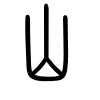
山 (Shān) - Montagne
三峰并立的大地屏障。
Trois pics montagneux.
山 shān: three peaks side by side — pure pictograph, one of the most visually immediate oracle bone characters. China's mountain ranges (Himalayas, Qinling, Kunlun) were not just scenery but the defining walls of the civilisational enclosure. Mountains = barriers = protection = isolation. The character is the landscape.

水 (Shuǐ) - L'Eau
弯曲的主流散落的水滴。
L'eau est la matrice.
水 shuǐ: flowing ripples — a central stream with water droplets either side. Water is the dominant force of Chinese geographical imagination: the Yellow River (黄河) gave birth to civilisation and periodically destroyed it; the Yangtze (长江) defined the cultural divide between North and South. Laozi used water as the supreme metaphor for the Tao: soft, yielding, yet wearing away the hardest rock.

田 (Tián) - Le Champ
沟渠划分为小块定居。
Le fondement sédentaire.
田 tián: a grid of irrigated paddy fields seen from above — the bird's-eye view of agricultural civilisation. The tic-tac-toe pattern encodes the well-field system (井田制 jǐngtiánzhì): eight families each farming their own plot surrounding a central communal field. The character is literally the social contract of the agricultural village, drawn in a single brushstroke.


日 (Rì) - Le Soleil
太阳,农历与作息根基。
Le cycle du temps.
日 rì: the sun — originally a circle with a dot inside (the corona). The solar cycle was the fundamental clock of agricultural life: planting by the sun, harvesting by the sun, calculating seasons by the sun. The Chinese lunisolar calendar (农历 nónglì) integrated solar terms (节气) — 24 precise seasonal markers guiding every agricultural decision across 3,000 years of continuous use.
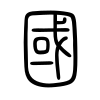
国 (Guó) - Le Pays
城墙与兵器拱卫的领土。
Territoire défendu.
国 guó: oracle bone form shows a walled enclosure (口 = boundary wall) containing a weapon or population marker. The character encodes the founding definition of a Chinese state: a defended territory. Compare with the Western concept of "nation" (born from natio = birth/origin) — one defines statehood through defence, the other through ethnic origin. The spatial logic differs from the start.
大地的囚笼与海洋的广场
Le continent enclavé s'opposant à la mer connectrice
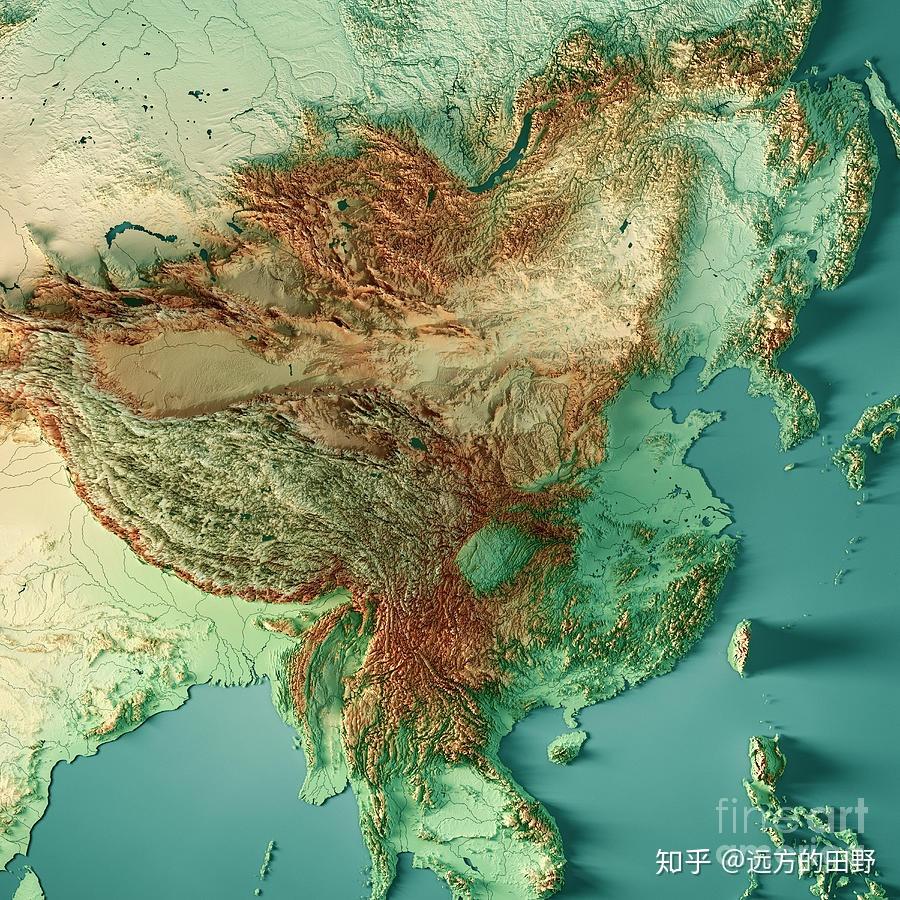
中西文明的根本差异,首先源自于它们所处的宏观地形结构。
La première graine de divergence civilisationnelle est topographique.
This topographic argument is the foundation of geographical determinism: before philosophy, before religion, before language, the shape of the land had already set the trajectory. China's enclosed plateau-desert-ocean perimeter created a world unto itself; the Mediterranean's interconnected coastlines created a permanent crossroads. The civilisational personalities that developed were responses to these physical facts.
🇨🇳 中原封闭地形 (L'enclave chinoise)
- 西南部:世界屋脊青藏高原(Himalaya)。
- 西北部:浩瀚的戈壁与沙漠(Gobi/Taklamakan)。
- 东/南部:浩瀚无垠的太平洋(Pacifique)。
巨大的天然地理屏障使中国成为一个半封闭的大陆国家。这带来了一种“天下即世界”的自足感,内向且稳定。
Entourée de déserts, de l'Himalaya et de l'océan, la Chine ancienne perçoit son territoire comme la totalité du monde (Tianxia). Culture introvertie et autosuffisante.
The concept of 天下 tiānxià ("all under Heaven") was not megalomania — it was geographical logic. If the Himalayas are your southern wall, the Gobi your northern barrier, and the Pacific your eastern horizon, then what you can see and reach is the world. China's self-perception as the "Middle Kingdom" (中国 zhōngguó) arose from this enclosed geography: you are naturally at the centre when you are ringed by impassable barriers.
🇬🇷/🇮🇹 地中海开放地形 (La Méditerranée)
- 内海网络:地中海是欧、亚、非三大洲的交通枢纽。
- 破碎的岛屿:希腊等地多山缺土,海岸线曲折。
陆地纵深极小,迫使居民向海洋拓展。海洋提供了四通八达的航线,造就了开放、商业、多文明交汇的海洋文明特征。
Une mer intérieure reliant 3 continents. Terres pauvres et côtes dentelées poussent vers un réseau maritime ouvert, commercial et cosmopolite.
The Mediterranean was a school for cosmopolitanism: Phoenicians, Greeks, Romans, Arabs, and Venetians all shared the same sea, competing and mixing. The Greek city-states developed democracy partly because their rocky terrain could not support large agrarian states — you had to trade, negotiate, and persuade rather than conquer and administer. The sea made argument necessary; argument made philosophy possible.
西高东低的世界阶梯与封闭网格
Le relief en terrasses : d'Ouest en Est
Première terrasse: Tibet (4500m) → Deuxième: Plateaux et bassins (1000-2000m) → Troisième: Grandes plaines côtières. Tous les fleuves coulent naturellement d'Ouest en Est vers la mer.
China's three-step terrain descends from the "roof of the world" (Tibetan Plateau) eastward to the coastal plains. This means all major rivers — Yellow River, Yangtze, Pearl River — flow east toward the Pacific, creating natural east-west transportation corridors but making north-south movement difficult. The terrain literally channelled history's flow.
树叶的命运:不同植被下的文明
Forêts décidues vs Forêts sclérophylles
生存环境(气候与植被)直接决定了人类最初是种田还是经商。L'écologie pré-détermine les modes de survie.
The ecological argument: before any emperor, philosopher, or general shaped Chinese history, the forests had already written the script. Broadleaf deciduous forests (oak, chestnut, maple) with their seasonal cycle and fertile leaf-litter soils are the natural home of intensive grain agriculture. Mediterranean sclerophyllous forests (olive, cork oak, maquis) on thin rocky soils are not — and that agricultural impossibility drove the Greeks to the sea.
🇨🇳 阔叶林文化:农耕·循环·稳定
黄河流域和长江流域属于温带/亚热带阔叶林。四季分明,雨热同期(春种秋收)。
土地肥沃,先民可以通过精耕细作养活庞大人口。形成了安土重迁、日出而作、循环往复的保守型农耕文明。
Forêts de feuillus à grandes feuilles. Saisons nettes et pluies estivales idéales pour l'agriculture intensive. Engendre une sédentarité profonde, la routine des saisons et le respect de la terre.
The Yellow River valley's loess plateau (黄土高原) is one of the world's deepest topsoil deposits — up to 100 metres of wind-blown silt accumulated over millennia, extraordinarily fertile and easy to cultivate with primitive tools. This is why Chinese civilisation settled here: the soil was a gift that made large sedentary populations possible before metallurgy or advanced irrigation. The land fed the civilisation that would define the next 4,000 years.
🇬🇷/🇫🇷 硬叶林文化:商贸·征服·流动
地中海式气候夏季炎热干燥,冬季温和多雨。典型植被是常绿硬叶林(如橄榄树、葡萄藤)。
这种环境不利于谷物大面积连片种植,但适合种植经济作物(榨油、酿酒)。这迫使西方先民出海进行商品交换和殖民夺取粮食(斯巴达、雅典),造就了流动与征服的基因。
Climat méditerranéen (étés secs) favorable aux sclérophylles (olivier, vigne) impropres aux grands empires céréaliers. Pousse à exporter du vin/huile pour importer du blé : genèse du commerce, de la navigation et de la conquête.
Greece's ecological paradox: the birthplace of Western philosophy, science, and democracy was also a land chronically short of grain. Attica's rocky hillsides could grow olives and grapes — but not enough wheat to feed Athens. The solution: trade olive oil and wine for Scythian grain from the Black Sea. This trade dependency forced Athens to develop contracts, courts, and commercial law — the institutional infrastructure of capitalism, all to solve a soil problem.
守望黄土:为什么产生保守主义
Pourquoi l'agriculture engendre-t-elle le conservatisme ?
以农为本的生存方式,深刻塑造了中国人的政治伦理与社会心理。Vivre de la terre a forgé une mentalité où la stabilité est la valeur suprême.
The agricultural personality: security over adventure, continuity over innovation, community over individual. These are not cultural accidents or ethnic characteristics — they are rational responses to an environment where deviation from proven methods means starvation. The farmer who experiments with a new crop and fails loses everything; the farmer who follows tradition survives. In an agricultural civilisation, conservatism is not backwardness — it is intelligence.
1. 土地不可移动 (Immobilité)
财富就是土地。农民被紧紧绑定在土地上不可轻易迁徙(安土重迁)。因此形成了极强的乡土观念和对故乡的眷恋。
La terre est fixe. Le paysan ne fuit pas. Naissent l'attachement viscéral aux racines et la peur du déracinement.
安土重迁 (ān tǔ zhòng qiān) — "settle comfortably on your land, think twice before moving." This four-character proverb encodes the entire psychology of agricultural rootedness. Even today, China's hukou (household registration) system reflects this ancient logic: your identity is tied to your home village, not portable like a citizen's passport. The land owns you as much as you own the land.
2. 经验的权威 (Autorité de l'expérience)
农业生产极度依赖气象规律和祖辈经验。老年人因为积累了最多经验,拥有绝对的权威。知识代表着“回溯过去”而非“创新”。
L'agriculture dépend des cycles climatiques connus. Les anciens détiennent le savoir vital. L'innovation est risquée, la tradition sauve.
This is the deepest root of Confucian elder-veneration: it was not mere sentiment — it was epistemological. The oldest farmer had survived the most unusual weather events; his memory was the community's risk-management database. This made innovation structurally dangerous: the new is, by definition, untested. Only when an elder could say "I saw this before and it worked" could new practices gain legitimacy. The past was the authority because the past had survived.
3. 宗族秩序 (Réseau clanique)
兴修水利、抗旱防灾、大家庭耕作需要极其严密的集体协作。这种需求催生了中国以血缘为纽带的宗族社会,压抑了个人主义。
Irriguer et récolter exige une main d'œuvre massive. L'individu s'efface au profit du clan (système patriarcal) essentiel à la survie collective.
Karl Wittfogel's "hydraulic society" thesis (1957) argued that large-scale irrigation management — dredging the Yellow River, building reservoirs, coordinating planting schedules across thousands of villages — necessitated a powerful centralised bureaucracy. You cannot manage the Yellow River without a state; therefore, having the Yellow River produces a state. Geography creates the government. Weber agreed: China's massive hydraulic infrastructure required and perpetuated its centralised imperial bureaucracy.
大河与文明:黄河、长江与欧洲大河的比较
Fleuves et Civilisations : Fleuve Jaune, Yangtsé, Loire, Rhin · Comparing Rivers that Built Civilisations
黄河的泵沙量是世界最高的大河之一(每年1.6全10万顿沙)。她孕育了中国文明,也母亲覇掘了她。历史上黄河汁滥共1593次,局部山洪就发生了2000+次。
Le Fleuve Jaune : berceau de la civilisation mais aussi "Chagrin de la Chine" (中国的忧患). 1593 inondations majeures en 3000 ans. Nourrit et détruit alternativement.
The Yellow River earned its nickname "China's Sorrow" (中国的忧患) from its catastrophic flood record — it changed course 26 times in 3,000 years of recorded history, sometimes shifting hundreds of kilometres overnight. Managing it required the centralised imperial bureaucracy that Weber identified as the key structural difference from European capitalism. The river that gave birth to Chinese civilisation also demanded the political system that defined it.
长江是中国的经济命脉,全长6380km,是中国南北文化分界的象征性界线。长江三角洲是世界最重要的第一大经济带第一大稀米主产区。
Le Yangtsé (6380 km) : axe économique de la Chine du Sud. Son delta produit la majorité du riz chinois. Frontière culturelle Nord-Sud.
The Yangtze is China's economic spine: 40% of China's GDP is generated in its basin. Its delta (Shanghai) is the world's busiest port region. The cultural divide it marks — wheat-eating, Mandarin-speaking North vs rice-eating, diverse-dialect South — persists in Chinese regional identity to this day.
莱茵河(Rhin)是欧洲的经济血脉,自古以来即是罗马、辛布锡、汉萨、法兰庆商贸与农业共存的设计;卡乔山谷、葡萄埼、居汉萨南辺的温和气候,形成高价微小网络的秘密。
Le Rhin : artère commerciale de l'Europe depuis Rome. Frontière politique, route économique, symbole romantique (Loreley). La vallée mosellane et le Palatinat : vignobles sur ardoise et calcaire.
The Rhine was Europe's commercial highway: Roman wine amphorae found in Germany, medieval Hanseatic trade goods, modern coal and steel barges. Unlike the Yellow River which demanded management from a central authority, the Rhine was shared among dozens of competing city-states, counts, and bishops — each extracting tolls, each competing for trade. Fragmented political geography produced the competitive institutional evolution that drove European capitalism.
卢瓦尔河是法国的文化聊求:法山城堡强调了生活艺术,法国独特的Terroir品居,形合着法国国内小型多元化较少属于高大山游离充足。
La Loire : le "jardin de la France". Châteaux royaux, vignes d'Anjou et de Touraine. Le fleuve qui a fait la douceur angevine et la civilisation de la villégiature aristocratique.
The Loire Valley (UNESCO World Heritage) embodies the French philosophy of terroir: its gentle climate, diverse soils, and moderate scale produce an extraordinary range of wines (Muscadet, Sancerre, Chinon) within 200km — exactly the kind of micro-diversity that Chinese continental geography cannot produce. The Loire made the châteaux possible; the châteaux made the cuisine culture possible; the cuisine culture became France's greatest soft-power export.
Fleuve Jaune = centralisation obligatoire. Rhin = concurrence politique multiple. L'un engendre l'Empire, l'autre le Capitalisme.
This is Weber's thesis in its purest geographic form: the Yellow River required a centralised empire to manage it; the Rhine's fragmented political landscape required competitive commercial institutions. Same river logic, opposite political outcomes. Geography wrote the first chapter; institutions wrote the rest.
雨水的政治:400毫米生命线
La ligne des 400 mm de précipitations
中国历史的宏大史诗,本质上是一部关于气候与降水的历史。L'histoire chinoise est dictée par la mousson.
The monsoon was the master clock of Chinese history. When the monsoon shifted south — as it did during cooling periods — the grasslands of Inner Mongolia and the Mongolian Plateau dried out. Nomadic herds died. Nomadic peoples had two choices: starve or invade. The agricultural south, which retained its rainfall, became the target. Chinese history's pattern of northern invasions is essentially a climate record disguised as military history.
- 生态限界:年降水量 400mm 等值线,是中国农业与游牧业的天然分界线。Sépare naturellement les terres arables de la steppe nomade.
The 400mm annual rainfall isohyet runs from the Greater Khingan Range (northeast) to the edge of the Tibetan Plateau (southwest) — almost exactly following the course of the Great Wall. North of this line: too dry for reliable grain agriculture. South of it: reliable enough for sedentary farming. The Wall did not create this boundary; the rainfall did. The Wall was humanity's attempt to mark on stone what the monsoon had already written in the soil. - 长城(La Grande Muraille):长城的走势几乎与这条降水线完美重合!这是农耕文明对抗游牧铁骑的防御堡垒。
气候冷却与游牧南侵 (Le froid et les invasions)
历史上,每当全球气温下降,降雨带向南推移:
北方的草原枯竭(牛羊饿死)。迫于生存压力,游牧民族(匈奴、突厥、蒙古、满清)必然疯狂南下,掠夺中原农业区的粮食。
中国历史上的数次大乱与王朝周期(如五胡乱华),背后往往是气候变冷在驱动。
Quand le climat mondial refroidit, la steppe au Nord s'assèche. Les nomades (Xiongnu, Mongols) affamés, sont forcés d'envahir le Sud agraire riche en grain. Les cycles d'invasions historiques correspondent souvent à des "petits âges glaciaires".
秦岭—淮河生态分界点
La ligne des Monts Qinling et de la Rivière Huaihe
La ligne Qinling-Huaihe divise la Chine en deux mondes : au Nord, blé et boulettes (温带); au Sud, riz et vapeur (subtropical). Aussi la frontière climatique 0°C en hiver.
This invisible line determines everything: wheat vs rice, bread vs steamed buns, north Chinese dialect (Mandarin) vs southern languages, Han furniture customs (chairs entered from the north, borrowed from nomads) vs traditional floor-level living. Even today, whether your apartment building has central heating (north does, south doesn't) is determined by this line drawn by rainfall and temperature 3,000 years ago.
天意难测:气候与文化心态
Harmonie avec le Ciel vs Conquête de l'Océan
🇨🇳 靠天吃饭与“天人合一”
农业文明极度依赖气候(暴雨、旱灾、蝗灾瞬间摧毁一切),人类在庞大的季风系统前显得渺小无力。
因此,中国思想史发展出“敬畏自然、顺应天时”的“天人合一”哲学。人不是自然的主宰,而是环境的一部分,寻求内在的和谐与修心。
L'agriculteur soumis aux caprices dévastateurs de la mousson développe une terreur sacrée. D'où l'harmonie philosophique ("Tianren Heyi") : l'homme est une fraction de la nature (Cosmos), il doit s'y fondre et non la dompter.
天人合一 (tiānrén héyī — "Heaven and Humanity as One") was not a comfortable platitude but a hard-won lesson from centuries of agricultural vulnerability. When drought or flood could destroy everything in weeks, the only sane response was to read the sky, study the seasons, and try to align human action with natural rhythms — not fight them. This produced Taoist naturalism, Chinese landscape painting's vastness (humans as tiny figures in immense landscapes), and feng shui's systematic study of environmental energies.
🇬🇷 主客二分与“征服自然”
海洋文明面对的是可以通过造船术、罗盘和航海知识克服的波浪。商业竞争需要探索未知、打破界限。
这催生了西方的“主客二分”视角。自然被视为人类(主体)可以客观研究、解剖并最终去征服与利用的客体(对象),孕育了科学实验冒险精神。
L'Océan se navigue grâce à la technique et l'audace. L'Occident développe la dichotomie "Sujet/Objet". La Nature est conçue comme un Object scientifique et matériel à comprendre, maîtriser, exploiter et vaincre.
The Cartesian dualism that shaped Western science — René Descartes (1596–1650): "I think, therefore I am" — posited a radical separation of thinking subject from extended material world. Nature became an "object" to be studied, measured, and ultimately mastered. This philosophical stance arose in the same northwestern European Atlantic context that had already spent centuries building ships to conquer unpredictable seas. Subject/object split = sailor/ocean split, scaled up into a worldview.
马克思·韦伯的断言
Max Weber et La Religion de la Chine (1915)
德国社会学家马克斯·韦伯 (Max Weber) 在比较社会学中认为,地理与生态塑造了两种完全不同的理性结构 (Rationalités)。
Pour Max Weber, l'espace écologique forge deux types de bureaucraties et de rationalités.
Weber's 1915 work The Religion of China (Konfuzianismus und Taoismus) asked a fundamental question: why did capitalism emerge in the Protestant West and not in China, which had sophisticated commerce, paper money, and complex markets for centuries? His answer: not intelligence or culture, but the type of rationality that each geography required. Managing floods requires centralised bureaucratic rationality. Trading across seas requires contractual, legal rationality. Two different problems produced two different institutional solutions.
农业官府 vs 航海私产
- 治水官僚 (Hydraulic Bureaucracy): 在中国修筑黄河大坝,必须建立一个高度中央集权的大政府。权力压倒资本。Maîtriser les fleuves géants exige un empire centralisé et un fonctionnariat ultra-puissant (Despotisme hydraulique).
Wittfogel's "Oriental Despotism" (1957) extended Weber: the Yellow River floods on average once every two years and had changed course 26 times in recorded history, killing millions each time. Managing this required the equivalent of a modern project management system across thousands of villages — which only a powerful central state could coordinate. The state that could control the water could tax and conscript everyone who depended on the water. Hydraulic power = political power. - 海商产权 (Maritime Capitalism): 航运贸易需要保护私人财产和契约法,这是欧洲资本主义萌芽的地缘基础。Le commerce maritime réclame des contrats (Loi) et la protection de la propriété privée (Bourgeoisie).
Mediterranean maritime commerce required institutions that Chinese hydraulic bureaucracy did not: contract law (what happens if the ship sinks?), property protection (the merchant needs to keep his profits), and dispute resolution between strangers (who arbitrates between a Phoenician seller and a Greek buyer?). These institutional needs drove the development of Roman law, the Justinian Code, and eventually the legal infrastructure of capitalism. The sea forced the invention of the contract; the river forced the invention of the bureaucrat.
地理词汇表:中华与欧洲文明的对应
Tableau trilingue · Chinese & European Civilisational Contrasts
| 维度 Dimension |
🇨🇳 中国 Chine · China |
🌊 地中海/欧洲 Méditerranée · Europe |
根因 Racine · Root Cause |
|---|---|---|---|
| 地形 Terrain |
封闭大陆 Continent enclavé Closed by Himalayas, Gobi, Pacific — a world unto itself |
开放海洋网络 Mer intérieure connectée Open Mediterranean linking 3 continents — permanent crossroads |
地理决定了初始接触模式 |
| 生产方式 Mode de prod. |
精耕细作农业 Agriculture intensive Loess soil + monsoon = high-yield grain farming possible for millions |
海洋贸易与殖民 Commerce maritime & colonies Thin soils → must trade oil/wine for grain → develops shipping/contract law |
土壤类型与降水决定初始生存策略 |
| 权力结构 Structure polit. |
水利官僚集权帝国 Despotisme hydraulique Yellow River management requires central coordination → empire |
竞争城邦/王国 Cités-États en concurrence Fragmented geography → competing states → no single authority to impose order |
大河管理 vs 海洋竞争 |
| 理性类型 Type de raison |
官僚行政理性 Rationalité bureaucratique The mandarin ideal: correct procedure, hierarchy, precedent, loyalty |
契约商业理性 Rationalité contractuelle The merchant ideal: profit calculation, legal contract, innovation, risk-taking |
韦伯"理性化"类型分化 |
| 自然观 Rapport nature |
天人合一 · 顺应 Harmonie cosmique Monsoon vulnerability → align with natural rhythms, not fight them → Taoism |
主客二分 · 征服 Dualisme Sujet/Objet Ocean navigability through technology → nature as object to master → Descartes |
对自然威胁的不同回应 |
| 时间观 Rapport au temps |
循环·治乱·天命 Cyclique (calendrier lunaire) Agricultural seasons → cyclical time → dynasties rise and fall like harvests |
线性·进步·末世 Linéaire (chrétien/laïc) Christian eschatology → progress toward an end → cumulative improvement possible |
农业时间 vs 宗教时间 |
| 地理美学 Esthétique |
风水·山水画·留白 Paysage cosmique (feng shui) Ink landscape painting: tiny humans in vast mountains = human as fraction of nature |
风土·透视画·比例 Terroir & perspective artistique Renaissance perspective: the human eye at the vanishing point = human as measure of all things |
大陆山水 vs 海洋人本 |
空间图盘:法兰西六边形 vs 中国黄土
L'Hexagone parfumé vs La Vaste Terre Jaune
🇫🇷 L'Hexagone (法兰西六边形)
法国的地形完美融合了海与陆的双重性格。
西临大西洋(开放贸易、探索界限 Finistère),南接温润的地中海,东靠阿尔卑斯山。它的面积适中,拥有异常丰富的气候微生态和丰饶的土壤。
这孕育了法国人对小块优质土地(Terroir)的极致追求(孕育了丰富的红酒和奶酪文化),以及既骄傲独立又崇尚普遍人权的海洋开放底色。
🇨🇳 神州大地 (Le Vaste Continent)
中国的地形是无比庞大的大陆性图景。
纵深极其辽阔,气象系统统一而刚烈。这并非细碎精美的马赛克,而是一块必须用天下一统的逻辑来统御的巨大版图。
它孕育了超大型的农业叙事、长城防御心理、以及极度追求集体稳定性和天人感应(风水 Fengshui)的大陆思维。小而美的浪漫必须让位于大范围的生存存续。
法国人将土地视为个性和感官享受的来源。同一山坡两边的葡萄园,因光照微差就能酿出迥异的红酒。地理是浪漫和享受(Gastronomie)。
Le sol est une identité gustative et esthétique. Célébration des micro-climats et de la jouissance de la Terre.
The French concept of terroir (literally "earth/soil") captures a philosophy radically different from feng shui: the soil is not a cosmic force to be respected and aligned with — it is a source of specific sensory pleasure to be explored and celebrated. Two vineyards separated by 100 metres of chalk vs clay produce wines with entirely different personalities. The French relationship with land is intimate, individualistic, and hedonistic. The Chinese relationship is cosmic, defensive, and collective.
中国人将地理视为气运和兴衰的密码。讲究背山面水(藏风聚气)。与其说是在享受土地,不如说是怀着敬畏之心在地脉中寻找安全的庇护所。
Le sol est une géométrie vitale et cosmique (Énergies Qi). On ne cherche pas la saveur du sol, mais son asile protecteur face au chaos.
Feng shui (风水, literally "wind and water") is China's systematic science of landscape energy: how topographic features channel qi (vital energy), which orientations protect and which expose, where to build a house, site a grave, or found a city. It is not superstition — it is a sophisticated environmental risk-management system, developed by agricultural people who knew that the wrong hillside meant flooding, drought, or erosion. Beijing's location (mountains behind, water in front) follows classical feng shui principles perfectly.
第七课 总结 · Résumé · Summary
亚洲大陆的封闭地形与季风阔叶林,决定了中国早熟的农业文明与天下世界观。
Himalaya, Gobi, Pacifique : trois murs créant une civilisation autosuffisante et introvertie (天下 Tianxia).
Before any philosopher wrote a word, the mountains, deserts, and ocean had already enclosed Chinese civilisation — creating a world unto itself that naturally thought of itself as the centre.
400毫米降水线是长城的基石,气候变冷驱动了游牧南侵——历史的规律其实是气候的规律。
L'isohyète 400mm = le tracé de la Grande Muraille. Les invasions nomades = des sécheresses climatiques déguisées en guerres.
The Great Wall followed the rainfall line. Every major nomadic invasion coincides with a documented climate cooling event. Chinese dynastic cycles are partly climate cycles in political disguise.
安土重迁、经验权威、宗族网络——农业文明的三大保守逻辑,皆源于土地的不可移动性。
Trois conservatismes agraires : immobilité foncière, autorité des anciens, solidarité clanique.
Agricultural conservatism is rational survival strategy: the farmer who experiments and fails starves. Tradition = the tested path that survived. Elders = the living memory of what worked.
天人合一 vs 主客二分——中国哲学融入自然,西方哲学征服自然。两种回应,两种文明命运。
天人合一 (Harmonie cosmique) vs Dualisme cartésien. Deux réponses géographiques à la même planète.
Neither was simply "right": 天人合一 sustained farming for 4,000 years; Cartesian mastery of nature powered the Industrial Revolution and ecological crisis simultaneously. Geography set the initial conditions; philosophy did the rest.