第八课:艺术 —— 琴棋书画
Leçon VIII : Les Arts — Guqin, Go, Calligraphie, Peinture
Lesson 8: The Arts — Music, Go, Calligraphy, Painting
The Four Accomplishments as a philosophy of moral cultivation — not performance but becoming
Université du Luxembourg · 文化对比系列
核心甲骨文 · Les Caractères Originels
琴棋书画的象形溯源
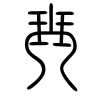
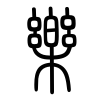
琴 (乐)
Musique/Instrument木上架丝之形
Fils de soie sur bois.
Wood frame + silk strings. 乐 yuè/lè: originally a stringed instrument; extended meanings: music, joy, happiness. The character itself is the instrument — the physical act of making music encoded in the written word.
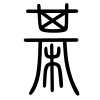
棋 (碁)
Jeu de Go石木之奕局
Pierres sur une grille/Stratégie.
棋 qí: from 木 (wood, the board) + 其 (phonetic). 围棋 wéiqí = "surrounding game." The oldest board game still played at the highest level — over 2,500 years old, with more possible board configurations than atoms in the observable universe.

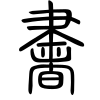
书
Calligraphie/Écrit手拿笔着墨于竹筒
Pinceau encré sur bambou.
书 shū: a hand holding a brush over a vessel — writing as a physical act of control and discipline. "字如其人" (the character reveals the person): in China, handwriting was character analysis, personality assessment, and moral biography all at once.

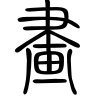
画 (畵)
Peinture/Tracer手执笔画出疆界形
Main traçant avec pinceau.
画 huà: a hand drawing a boundary line with a brush inside a frame. The act of painting is literally the act of demarcating space — defining what is inside (subject) and outside (background). Chinese ink painting's philosophy of emptiness (留白) starts with this character: the painter decides what not to fill.
四艺的文人精神
道德乌托邦的延伸
L'Utopie Morale et Spirituelle
在《中国思想史》的视野下,中国四艺(琴棋书画)从不追求纯粹的技巧本身,而是追求最高级的人格修养。儒家文化将道德抬高至绝对地位,塑造了独特的“道德乌托邦”。
This contrasts deeply with Western art, which historically pursued mimesis (imitation of nature), technical mastery, and divine glorification.
魏晋时期,随着名教(儒家礼法)的衰败,文人开始转向自然(Ziran - Naturalness)。艺术成了通往“道”的方式。
En Chine, l'art n'est pas une fin en soi (maîtrise technique absolue), mais un outil de perfectionnement moral et philosophique. Des règles strictes du Confucianisme "Mingjiao" à la spontanéité taoïste "Ziran" de l'époque Wei-Jin.
中国艺术的本质:自然与"意"
中国艺术本质上是儒释道(儒家、佛教、道教)思想的延伸。最高境界在于传达"意"(l'Intention / l'esprit profond)而非其表象(形)。苏轼名言:「论画以形似,见与儿童邻」 — 以形似论画者,不过如小儿之见。
L'essence de l'art chinois n'est pas la représentation photographique (mimesis). Il vise à exprimer le «Yi» (意) — l'intention spirituelle profonde de l'objet — tout en maintenant l'harmonie avec la nature. Su Shi (Dongpo) le dit : «Juger un tableau par sa ressemblance, c'est l'œil d'un enfant.»
Su Shi (蘇軾, 1037–1101): "To judge painting by likeness is the vision of a child." — The goal is not photographic accuracy but spiritual resonance (气韵生动 qìyùn shēngdòng): the vital breath and rhythm of the subject must live in the brushstroke.«La résonance vitale et le mouvement du Qi» — Le premier et plus important des Six Principes de la Peinture.
The painting must breathe. Before composition, color, or brushwork — the vital energy (Qi 气) must be present and living. This is why Chinese masters could spend decades painting bamboo: not to copy bamboo, but to become bamboo.
东西方绘画哲学对比 · Comparaison Philosophique
🏛️ OCCIDENT / WEST
数学透视法 / Perspective géométrique
解剖学精准 / Précision anatomique
再现物质世界 / Imiter la réalité
光影与立体 / Clair-obscur
Goal: rational truth of the visible world
🖌️ CHINE / CHINA
气韵生动 / Qi vital
留白哲学 / Le Vide (Liubai)
意境传达 / Esprit (Yi)
散点透视 / Perspective flottante
Goal: spiritual truth beyond the visible
三教合一的艺术观 · Les Trois Voies
儒家:艺术是修身工具,服务于道德人格。
道家:艺术应顺应自然,超越人工雕琢。
佛家:艺术是观照内心、领悟空性的途径。
Confucianisme : l'art cultive la vertu. Taoïsme : l'art suit la nature spontanée. Bouddhisme : l'art révèle le vide (空 kōng) et la conscience intérieure.
These three philosophies were not in conflict — Chinese literati drew from all three simultaneously. A calligrapher's brush discipline was Confucian; his spontaneous strokes were Daoist; his meditative focus was Buddhist.乐:礼乐制度与演变
礼乐制度 · Le Système des Rites et de la Musique
殷商时代,"乐"(yuè)本质上是为祭祀神灵。西周之后,周公旦制定"礼乐制度"(Rites et Musique),将乐作为统治和等级秩序的核心工具。不同阶层只能欣赏不同规模的雅乐。
À l'origine, la musique servait aux rituels sacrificiels (Shang). Sous les Zhou occidentaux, le duc de Zhou codifie le «Système des Rites et de la Musique» : la musique devient un outil de gouvernance pour réguler la société, les émotions, et affirmer la hiérarchie sociale.
The Rites of Zhou (周礼) strictly regulated which music each social rank could hear and perform. Emperors could have 8 rows of 8 dancers; lords had 6 rows; officials 4. To exceed your rank in music was a political crime — hence Confucius's outrage: "If this can be tolerated, what cannot be tolerated?"«Si cela peut être toléré, que ne peut-on pas tolérer ?» — Confucius, face à un seigneur usurpant la musique impériale.
Confucius used this phrase when a lesser lord performed the Emperor's 8-row dance. Using the wrong music was not aesthetic offense — it was political treason against cosmic order.
古乐的衰亡 · Le Déclin de la Musique Classique
由于"礼乐"对治国的实际效用逐渐式微,古乐的政治地位大幅下降。民间俗乐(戏曲、民歌)兴起,宫廷雅乐规范失传。大量古代乐谱和演奏法因此永久消失。
Avec le déclin de son utilité politique, la musique classique de cour (雅乐 yǎyuè) perdit son statut. La musique populaire — opéra, chansons folkloriques — prit le dessus. Une grande partie de la musique savante antique est perdue à jamais.
This is one of China's greatest cultural losses: because ancient music's purpose was political-ritual (not artistic), when the system collapsed, no one preserved it for aesthetic reasons. The guqin repertoire that survives represents only a fragment of what once existed.马克斯·韦伯的观察 · Max Weber
社会学家马克斯·韦伯(Max Weber)指出:西方音乐走向了理性化与数学化(平均律、复调、和声体系);而中国音乐由于长期固化于政治礼仪功能,在结构上相对停滞。
Max Weber observa que la musique occidentale s'est «rationalisée» — tempérament égal, polyphonie, harmonie fonctionnelle — tandis que la musique chinoise, figée dans son rôle rituel et politique, a connu une stagnation structurelle relative.
Weber's thesis (from "The Rational and Social Foundations of Music"): Western music's rationalization (12-tone equal temperament, harmonic progression, written notation) paralleled the rationalization of Western capitalism and law. Chinese music's conservatism reflected its conservative social function.琴:古琴 vs 钢琴
Philosophie du Timbre vs Harmonie
古琴(Guqin)是中国乐器中最具文人色彩的乐器。其哲学在于音色(Timbre)与余音的控制。琴有七弦,散音、泛音、按音,意在孤芳自赏或遇知音(如伯牙子期)。
Le Guqin (Cithare chinoise) incarne la philosophie du timbre. L'attention est focalisée sur les nuances infinitésimales de chaque note, le silence entre elles, et la résonance. Il est joué pour l'introspection ou pour un seul ami (Zhiyin).
The Guqin is historically the instrument of the literati. It is played not for performance, but for self-cultivation (修身). The ideal audience is oneself, or a "Zhiyin" (Knower of the Tone) — a soulmate who truly understands one's mind through the music. The strings represent elements of nature, and playing is an act of communion with the Dao.
Le Piano Occidental
钢琴则代表了西方音乐的和声学(Harmonie)架构与建筑般的宏大叙事。钢琴是为公开演奏(Concert)、和弦架构以及表达强烈冲突和力量而生。
Le piano est architectural : il repose sur l'harmonie multivoix, développé pour les salles de concert publiques, visant à maîtriser un espace acoustique riche et complexe.
民族乐器概览
Aperçu des instruments chinois

书:汉字本身的艺术
La Calligraphie : Liberté dans le cadre
极致规矩下的自由
法国等西方学者对汉字书法极度着迷,因为拼音文字难以演化为如此深度的独立视觉艺术。汉字提供了一个极其严格的法度“方块框架”。
La calligraphie est l'art ultime pour les lettrés chinois. Elle fascine en Europe car l'alphabet phonétique s'y prête moins. Elle exige des règles extrêmement strictes, mais offre une liberté absolue à l'intérieur de ce cadre.
古代知识分子追崇书法,是因为笔墨的变化直接对应了书写者当下的呼吸、心跳乃至道德修养与性格(“字如其人”)。
颜真卿的《祭侄文稿》之所以伟大,不在于结构完美,而在于其突破了规矩,将极度的悲痛完全倾注于笔墨之间。
L'écriture révèle l'âme. Une calligraphie n'est pas qu'un beau texte, c'est l'électrocardiogramme de l'état d'esprit et de la vertu du lettré à un instant précis.
汉字书体演变与分类
Les différents styles d'écriture chinoise
隶书
Style des scribes (Clérical)
楷书
Style régulier (Standard)
Regular script: The foundation. Law, structure, moral rectitude.
行书
Style semi-cursif (Courant)
Running script: Everyday expression. Fluid, connected, personal.
草书
Style cursif (Herbe)
Grass script: Pure abstraction and emotion. Read as music.
水墨画:留白与山水哲学
La Peinture à l'encre : Philosophie du Vide (Liubai)
人类历史上,基本上只有中西方文明诞生了独立且高度发达的“风景画/山水画(Paysage / Shanshui)”。
留白的张力
Le Vide (Liubai)
西方绘画用颜料铺满整张画布;中国水墨画刻意在大面积的纸上“无墨”,留出空白。这片空白是水,是云,是道,是无限的想象空间。
En Occident, la toile entière est couverte de peinture. La peinture chinoise crée une tension métaphysique en laissant de vastes zones blanches (le Vide). Ce vide est respiration, nuages, ou l'infini spirituel.
Liubai ("leaving white"): The most crucial concept. The unpainted silk/paper is not empty space; it is space. It represents water, mist, or the infinite scale. You cannot have the solid without the empty.
借山水解脱
Libération par le Paysage
古代文人仕途受挫或面临社会黑暗时(如宋元变革),放弃对社会现实的描绘,转而寄情于客观且永恒的山水之间,以此追寻内心的解脱与精神乌托邦。
Les lettrés, frustrés par des crises politiques, se sont tournés vers la nature éternelle pour trouver l'évasion spirituelle et se détacher des douleurs du monde.
两大基本画法:工笔与写意
Gongbi (Méticuleux) & Xieyi (Libre / Expressionniste)
工笔 (Gongbi)
Style méticuleux et réaliste
Gongbi ("meticulous brush"): Highly detailed, precise. Used for court portraits.
写意 (Xieyi)
Style libre, capture de l'esprit (Yi)
Xieyi ("writing intention"): Freehand. Goal isn't realism but spirit (Qi).
围棋:道与天下
Le Jeu de Go : Stratégie de l'Univers
围棋(Go)代表了古代中国人的宇宙观:“天圆地方”。棋盘由纵横直线构成网格,黑白两子代表阴阳运转。
Le jeu de Go représente la cosmologie chinoise : le plateau carré est la terre, les pierres circulaires sont le ciel. Le noir et le blanc symbolisent l'interaction dynamique du Yin et du Yang.
- 无阶级之分 / Équilibre: 所有棋子地位平等,依靠位置(位势)发挥作用。
Every stone is identical in value until placed. Its power comes entirely from its context and connection. A profound metaphor for Confucian relations. - 包围哲学 / Le Combat: 意图在于围地,而非单点击杀。
Unlike Chess which is a war of attrition ending in death, Go is a game of market share and co-existence. You win by controlling slightly more territory.
西洋棋 (Echecs) 的隐喻
与之对比,国际象棋反映了欧洲封建社会的等级架构体系(皇、后、骑士、主教、平民)。游戏的核心是目标明确的“弑权”(将死国王 Echec et Mat)。
Les Échecs occidentaux reflètent la société féodale européenne (Rois, Chevaliers, Pions) et se concentrent sur l'élimination directe du monarque adverse. Le Go, lui, est un jeu de contrôle géopolitique de l'espace abstrait et d'influence.
围棋与象棋
Le Go et le Xiangqi (Échecs chinois)
围棋 (Weiqi / Go)
Stratégie d'influence et de territoire. Égalité des pierres.
象棋 (Xiangqi)
Bataille hiérarchique : éliminer le Général adverse (Le Roi).
AlphaGo与围棋悖论
AlphaGo et le paradoxe du Go
L'IA bat Kasparov aux Échecs. Le Go reste intouchable en raison de sa complexité.
Chess solved via brute-force calculation. Go remained impossible due to its branching factor (10^170 states).AlphaGo bat Lee Sedol par l'intuition (réseaux de neurones).
AlphaGo beats Lee Sedol by mimicking human "intuition" via deep learning.Un coup calculé à 1 sur 10 000 chances d'être joué par un humain. Rédéfinit la théorie millénaire du Go.
Move 37 changed Go history. It was so far outside human tradition commentators thought it was a mechanical error.Leçon Philosophique :
Pendant 2500 ans, les humains pensaient jouer au Go de manière optimale. L'IA a prouvé que notre "sagesse" était entachée de dogmes.
For 2500 years, humans thought they were approaching the "truth" of Go. AlphaGo proved we were stuck in local aesthetic optima. In a profound Daoist turn, the machine taught humans to discard rigid dogmas and return to a "beginner's mind" (初心).汉法文化镜像 · Miroir Culturel
📍 法国 / 西方(France / Occident)
理性的再现 · Représentation Rationnelle
从古希腊"模仿论"(Mimesis)到文艺复兴,再到巴黎法国美术学院(École des Beaux-Arts)。西方艺术追求解剖学精确、几何透视、光影塑形,认为艺术的最高使命是再现物质世界的真实,进而彰显神圣的完美秩序。
De la mimesis grecque à la Renaissance, puis à l'École des Beaux-Arts de Paris : l'art occidental est fondé sur la raison — perspective géométrique (Alberti), anatomie (Léonard de Vinci), clair-obscur (Caravage). L'art sert à représenter le monde visible avec exactitude scientifique.
Key figures: Leonardo da Vinci studied anatomy to paint muscles; Alberti invented mathematical perspective; the Beaux-Arts system in Paris (founded 1648) systematized these principles as universal laws of "good art" — exported globally through colonialism.艺术观差异·核心词汇
Perspective
Anatomy
Harmony
Chiaroscuro
透视法
解剖学
和声
明暗法
散点透视
骨法用笔
意境
留白
📍 中国(Chine)
精神的投射 · Projection Spirituelle
"琴棋书画"的终极目标不是艺术本体,而是造就拥有至高道德人格的"君子/圣人"。艺术是内心情感与哲学体悟(佛家虚空、道家自然)的外在出口。"忘形得意"——超越物质形态,直达精神本质。
Le but ultime des Quatre Arts n'est pas l'objet artistique lui-même, mais la formation d'un «Junzi» (homme noble) d'une vertu suprême. L'art est une soupape d'expression de la vie intérieure — philosophie bouddhiste du vide, spontanéité taoïste. «Oublier la forme pour saisir l'esprit» (忘形得意).
"Forget the form, capture the spirit" (忘形得意 wàng xíng dé yì): The ultimate Chinese aesthetic principle. A painting of bamboo that looks exactly like bamboo but has no spiritual energy is worthless. A painting that barely suggests bamboo but vibrates with the artist's inner state is priceless.«La calligraphie et la peinture ont la même source.» — Zhao Mengfu (趙孟頫), maître des Yuan.
In China, painting and writing use the same brush, the same ink, the same energy. A calligrapher painting a mountain is simultaneously writing a character. This unity is alien to Western art, where writing and image are entirely separate systems.
第八课总结 · Conclusion de la Leçon VIII
① 修心优于技艺 · Cultiver l'Âme avant le Geste
在中国思想史框架下,文人借由「琴棋书画」逃离政治黑暗,追求个人道德乌托邦与人格纯粹。艺术是修行(修身)的工具,而非展示才艺的舞台。
Dans la tradition chinoise, les Quatre Arts sont avant tout des outils de cultivation morale. Les lettrés, frustrés par la politique, s'en servaient pour construire une utopie intérieure et purifier leur caractère. L'art est une discipline, non une performance.
A master calligrapher would spend hours in seated meditation before lifting the brush — not to warm up physically, but to empty the mind of ego. The art begins before the art begins.③ 东西方的深层分歧 · La Divergence Fondamentale
西方艺术(法国、意大利)最终走向了"为艺术而艺术"(L'Art pour l'Art),追求审美的自律;中国艺术始终坚持"为人格而艺术"——艺术服从于伦理,形式服从于精神。
L'art occidental évolua vers «l'Art pour l'Art» (autonomie esthétique pure). L'art chinois maintint toujours sa subordination à l'éthique — la forme reste au service de l'esprit et de la vertu. Ce n'est pas une infériorité, c'est une philosophie différente.
Neither tradition is superior. The West built Beethoven, Michelangelo, and cinema. China built the guqin, ink landscape, and calligraphy as biography. They are parallel answers to the same question: "What is art for?"② 尚意弃形 · L'Esprit au-delà de la Forme
不论是古琴独抚,书法挥洒,水墨留白,还是棋局纵横,核心原则皆遵循老庄"道法自然"——寻求摆脱物理束缚,抵达精神的高度自由(逍遥游)。
Qu'il s'agisse du guqin, de la calligraphie, de la peinture à l'encre ou du Go, le principe central suit la voie taoïste : transcender la forme physique pour atteindre la liberté spirituelle absolue (逍遙遊 — Libre Errance de Zhuangzi).
Zhuangzi's "Free and Easy Wandering" (逍遥游 Xiāoyáo Yóu) is the philosophical ideal: the artist moves through the art form without being constrained by it — like a master chef whose knife never dulls because he finds the natural spaces in the ox.④ 天人合一 · L'Unité du Ciel et de l'Homme
四艺的终极目标是实现"天人合一"——人与宇宙的和谐共鸣。弹琴时,琴弦振动与宇宙之气共振;挥毫时,笔墨流动与大化同频。这是中国哲学对"艺术意义"的终极回答。
L'objectif ultime des Quatre Arts : réaliser «l'Unité du Ciel et de l'Homme» (天人合一). Jouer du guqin, c'est vibrer avec le cosmos. Peindre une montagne, c'est être la montagne. L'art est communion, pas représentation.
"The unity of Heaven and Humanity" (天人合一 Tiān Rén Hé Yī): The practitioner does not observe nature to paint it. They become nature. The boundary between self and cosmos dissolves in the act of art. This is the Four Arts' deepest purpose.核心概念 · Concepts Clés · Key Concepts
知音 Zhīyīn
字面:了解你音乐的人。引申:真正理解你内心的灵魂挚友。
«Celui qui connaît ta musique» — l'ami de l'âme qui comprend ton cœur à travers l'art. "Knower of the Tone" — a soulmate who understands your soul through music. Origin: Bo Ya smashed his guqin after Zhong Ziqi died — no one left to truly hear him.留白 Liúbái
字面:留出空白。绘画中有意保留的未着墨区域,代表水、雾或无限。
«Laisser le blanc» — l'espace vide intentionnel dans la peinture : eau, brume, ou l'infini spirituel. "Leaving white." The intentional empty space in painting, silence in music, uncontested territory in Go. The void is not absence — it is the most powerful presence.气韵 Qìyùn
字面:气息与韵律。中国绘画第一法则,指作品中流动的生命能量与节奏感。
«Résonance vitale du Qi» — le premier des Six Principes de la Peinture (谢赫六法) : l'énergie vivante qui doit animer toute œuvre. Vital breath and rhythm. The first of Xie He's Six Laws of Painting. A work without Qi is technically perfect but spiritually dead. The brush must carry the artist's living energy.意境 Yìjìng
字面:意图与境界。作品唤起的那种只可意会、无法言传的氛围与情感空间。
«L'espace de l'intention» — l'atmosphère émotionnelle et spirituelle évoquée par une œuvre, au-delà des mots. "Atmosphere of intention" — the emotional-spiritual dimension an artwork evokes that cannot be fully described in words. A great shanshui painting creates an yijing you want to inhabit.写意 Xiěyì
字面:书写意图。自由挥洒的绘画风格,捕捉对象精髓而非精确外形。对立面:工笔(Gōngbǐ)。
«Écrire l'intention» — style pictural libre visant l'esprit plutôt que la forme précise. Contraire de Gongbi (méticuleux). "Writing the Intention" — freehand style. The goal isn't to copy nature but to transmit its essence. A xieyi bamboo may have three brushstrokes — and contain more life than a photorealistic one.天人合一 Tiān Rén Hé Yī
字面:天与人的合一。中国哲学最高理念:人与宇宙相互融合,艺术是实现此境的途径。
«L'Unité du Ciel et de l'Homme» — l'idéal philosophique suprême : la fusion de l'être humain avec le cosmos à travers la pratique artistique. "The Unity of Heaven and Humanity" — the ultimate goal of the Four Arts. The practitioner does not observe nature to depict it. They dissolve into nature. Art is the vehicle of cosmic communion.