第九课:建筑 —— 木石之间与礼制空间
Leçon IX : L'Architecture — Bois, Pierre et Ordre Spatial
Lesson 9: Architecture — Wood, Stone, and Spatial Order
The structural manifestation of Confucian hierarchy and Daoist freedom.
Université du Luxembourg · 文化对比系列
核心甲骨文 · Les Caractères Originels
建筑元素的象形溯源
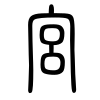
宫
Palais (Pièces multiples sous le toit)Palace: Multiple rooms connected under a single massive roof. Symbolizes centralized power and shelter.
门 (門)
Portes (Deux battants symétriques)Gates: Symmetrical double doors. The threshold between inner (private/sacred) and outer (public/profane).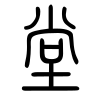
堂
Salle (Bâtiment sur haute fondation)Hall: Built on a raised earth platform. Reflects status; the higher the platform, the greater the authority.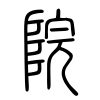
院
Cour (Mur encerclant l'espace)Courtyard: Space enclosed by walls. The core module of Chinese architecture, focusing inward rather than outward.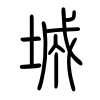
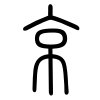
城/京
Cité (Mur défendu par des armes) / CapitaleCity/Capital: A walled enclosure defended by weapons. In China, a city implies a wall; the psychological need for boundaries.木构体系 vs 石构体系
🏛️ 西方石构 · Pierre (Occident)
征服重力,对抗时间。 从古埃及金字塔到古希腊神庙,再到哥特式大教堂,西方选择石头追求物质的永恒不朽(Éternité matérielle)。石头是对神的献礼,是权力的凝固,是征服自然的宣言。
De la Pyramide au Parthénon, des arènes romaines aux cathédrales gothiques : l'Occident bâtit en pierre pour défier le temps et la gravité. La pierre est une offrande à Dieu, un monument au pouvoir, et une déclaration de domination sur la nature.
Stone architecture says: "We defy time." The Pantheon in Rome has stood 2,000 years with no maintenance. Notre-Dame's walls will survive millennia. The message is permanence — the State, the Church, and God are eternal, and their buildings must prove it.La pierre peut devenir une montagne, la terre peut devenir la Terre elle-même.
Chinese gardens imitate nature by stacking Taihu stones into fake mountains — but the philosophical intent is the opposite of Western stone buildings. In China, stone mimics nature; in the West, stone conquers it.
🌲 中国木构 · Bois (Chine)
顺应生命,随时而化。 中国人选择木头,不是因为无法建造石头建筑,而是因为木头有生命、可更新。木材会腐朽,但它符合儒道两家对生命轮回(Cycle perpétuel)和生生不息的宇宙观。
La Chine choisit délibérément le bois — non par manque de savoir-faire en pierre, mais parce que le bois vit. Il pourrit, il se renouvelle : c'est le cycle de la vie (Dao). L'éternité chinoise ne réside pas dans le matériau, mais dans la transmission du lignage, du texte et de l'esprit.
China had stone technology — the Great Wall uses stone. But palaces, temples, and homes were deliberately built in wood. The Yingzao Fashi (营造法式, the Song-dynasty architectural manual) codifies a complete timber-frame system that was replicated and renewed for 1,500 years.深层哲学对比 · Philosophie Comparée
征服自然 / Dominer la nature
神圣的纪念碑 / Monument divin
Matter = Memory
融入自然 / Harmonie naturelle
文脉的传承 / Transmission textuelle
Spirit = Eternity
榫卯:阴阳的物理投射
榫卯原理 · Le Principe du Sun Mao
中国木构建筑极为罕见地不使用一根铁钉,而是依靠凸出的"榫"(Yang,公)嵌入凹陷的"卯"(Yin,母)完成咬合。两段木材通过彼此的凹凸形态互相锁定,无需外力强制约束。
L'architecture en bois chinoise n'utilise aucun clou. Le Sun (tenon convexe, Yang) s'insere dans le Mao (mortaise concave, Yin). Deux pieces de bois se verrouillent mutuellement par leurs formes complementaires — sans contrainte metallique externe.
The Mortise-and-Tenon system (Sun Mao) has over 6,000 recorded joint variations in ancient Chinese carpentry manuals. Each joint is tailored to the specific structural stress it must carry: compression, tension, shear, or torsion. No two joints are identical.应县木塔 · La Pagode de Yingxian — Miracle Antisismique
应县木塔(1056 CE):高67米,无钉无铆,历经近千年地震与战争巍然不倒。秘密正在于榫卯关节的弹性耗能——地震来临时,接点微微松动转动,吸收振动能量,而非强硬对抗。这正是道家"柔弱胜刚强"的建筑实践。
La Pagode en bois de Yingxian (67m, 1056 CE) — la plus haute structure en bois du monde — a survecu mille ans de seismes. Secret : les joints Sun Mao s'articulent legerement pendant un tremblement de terre, absorbant l'energie par flexibilite plutot que resistance rigide.
Modern earthquake engineers have confirmed the Yingxian Pagoda's timber joints act as passive energy-dissipation devices — exactly like modern seismic isolation systems, invented 1,000 years earlier. This is the Daoist principle "the soft overcomes the hard" (柔弱胜刚强) encoded in structural engineering.榫 (Yang) ⟷ 卯 (Yin)
凸为榫(Yang),凹为卯(Yin)
Le tenon (plein, Yang) s'imbrique dans la mortaise (creux, Yin)
«La chose la plus souple au monde vainc la plus dure.» — Laozi, Tao Te Ching, Ch. 78
This Daoist principle is literally engineered into Chinese architecture. The flexible wood joint survives earthquakes by yielding; the rigid stone monument survives by brute force. Both work — but they encode entirely different philosophies of power, time, and what it means to endure.
中轴线与礼制空间
礼制转化为空间 · Rites → Espace
儒家将社会秩序(尊卑、长幼、内外)直接转化为空间秩序。中轴线(南北向绝对中心线)是政治权力的脊梁:皇帝居中,百官居侧;主殿居中,偏殿居侧。空间位置即政治地位。
Le Confucianisme traduit l'ordre social (supérieur/inférieur, intérieur/extérieur) en ordre spatial absolu. L'Axe Central Sud-Nord est la colonne vertébrale du pouvoir : l'Empereur au centre, les ministres sur les côtés. La position dans l'espace est le rang politique.
The central axis of Beijing stretches 7.8km from Yongding Gate in the south to the Drum Tower in the north — the longest urban central axis in the world. Every imperial building of importance sits exactly on this line. To build off-axis was architecturally and politically impossible.坐北朝南 · Orientation Sud-Nord
所有重要政治建筑必然坐北朝南:背靠寒冷的北风(山),面朝温暖的阳光(南),象征君临天下、光明普照。这既是气候科学(背山挡风,向阳纳暖),也是宇宙政治学(天子面南而坐)。
Toute architecture impériale est orientée Sud : le dos protégé par la montagne froide du Nord, le visage tourné vers le soleil du Sud. C'est à la fois logique climatique (vents sibériens bloqués) et symbolique cosmologique (le Fils du Ciel regarde vers le Sud).
The Emperor sits on his throne facing South — the Yang direction of light and warmth. Subjects kneel facing North, backs to the sun. Even today in China, a south-facing apartment commands a price premium. The Confucian spatial hierarchy persists in the real estate market.西方城市 vs 中国城市 · Comparaison Urbaine
西方(古罗马、中世纪欧洲):城市往往以教堂或广场(Agora/Forum)为辐射中心,有机扩展,形态不规则,公共空间开放外向。
中国(长安、北京):城市是严格的棋盘式网格,宫殿居中,市井居外,礼制等级决定建筑位置,权力从中心向外扩散,内向封闭。
Occident : villes à rayonnement organique depuis une église ou une agora — ouvertes, publiques, chaotiques. Chine : grille parfaite, palais au centre — un système de coordonnées du pouvoir hiérarchique absolu.
Chang'an (唐代长安, pop. ~1 million in 700 CE) was the world's largest planned city: a perfect rectangle, 84 sq km, with 108 walled wards (坊) arranged in a grid, the Imperial Palace in the north-center. Urban design as political theology.«Choisir le centre pour établir le pays, choisir le centre pour bâtir le palais.» — Zhou Li (周礼)
This principle from the Zhou Rites (周礼) — one of the oldest Chinese administrative texts — became the foundational law of Chinese urban planning for 3,000 years. The center is sacred, political, and cosmic simultaneously.
故宫的空间逻辑:院与墙
院落矩阵 · La Matrice de Cours (Siheyuan)
北京故宫并非一栋孤立巨型建筑(如卢浮宫),而是由9,999间房间与无数院落嵌套组成的超级矩阵。院落(四合院)是中国建筑的核心模块:高墙围合的内向空间,将神圣的内部与世俗的外部截然分开。
La Cite Interdite n'est pas un bloc monolithique comme le Louvre, mais une matrice imbriquee de cours fermees — 9 999 pieces, 980 batiments. Le Siheyuan (cour interieure a quatre facades) est le module de base de toute l'architecture chinoise : il tourne le dos au monde exterieur.
9,999 rooms — not 10,000. The number 10,000 (万 wan) belonged to Heaven alone. The Emperor humbly stopped one short. This is cosmological humility encoded in architecture. The Forbidden City was built 1406–1420, employing over 1 million workers over 14 years.«La porte du seigneur est profonde comme la mer.» — Cui Jiao (Tang Dynasty)
Chinese spatial depth is social depth. The deeper the courtyard, the higher the status — and the more inaccessible. The Emperor in the innermost court: the ultimate expression of untouchable, hidden power.
门的政治学 · La Politique des Portes
故宫的每一道门都是社会阶层的过滤器。从天安门(官员入内)→ 午门(高级官员)→ 太和门(皇家活动)→ 乾清门(皇帝内廷):空间越深,资格越严,政治权力越绝对。没有资格的人绝对无法越门一步。
Chaque porte est un filtre social strict. De la Porte Tiananmen (fonctionnaires) a la Porte Meridienne Wumen (hauts dignitaires) jusqu'a la Porte Qianqing (famille imperiale) : plus on penetre, plus le rang requis est eleve. L'architecture enforece le contrat social physiquement.
The nested gate system perfectly encodes Confucian "gradation" (差等 cha deng): everyone has a precise relationship to the center, and no one may enter beyond their designated depth. To cross an unauthorized threshold was a capital crime. Architecture as law.故宫 vs 凡尔赛 · Deux Philosophies du Pouvoir
凡尔赛宫是展示性的:镜廊向所有人敞开,花园公开壮观——路易十四的权力需要被看见。故宫是隐蔽性的:高墙深院,皇帝隐于不见——中国皇权的神秘需要被隐藏。前者说"看我",后者说"你看不到我"。
Versailles est exhibitionniste : galerie des Glaces publique, jardins spectaculaires — le pouvoir de Louis XIV se montre. La Cite Interdite est hermetique : hauts murs, cours profondes — le pouvoir imperial chinois se cache. L'un dit «Admirez-moi», l'autre dit «Vous ne pouvez pas me voir».
Louis XIV deliberately opened Versailles to courtiers to surveil and control them — visibility was governance. The Chinese Emperor deliberately hid behind layers of walls — invisibility was divinity. Two completely opposite theories of royal power, perfectly expressed through architecture.风水作为建筑选址科学
Le Fengshui (Vent et Eau) : Science de l'Implantation
呼应第七课地理与气候
中国建筑并非突兀地插入大地,而是必须顺应地形与气脉。“背山面水”(Adossé à la montagne, face à l'eau)是最理想的风水格局。山用来阻挡西北西伯利亚的冷风,水用来保证农业灌溉与微气候。
Lié aux contraintes géographiques (Leçon 7), le Fengshui cherche le site optimal. La montagne protège du vent froid du nord, l'eau au sud offre vitalité et irrigation.
"Back to the mountain, facing the water." Fengshui (Wind and Water) is practical: mountains block Siberia's freezing north winds, while southern rivers supply irrigation and vital energy.
风水学实际上是早期的环境科学、地质学与心理学的结合。它认为人与自然并不是征服与被征服的关系,而是居住者必须寻找与其生命气场“共振”的空间。
Plus qu'une superstition, le Fengshui est la protoscience environnementale chinoise. Contrairement aux bâtisseurs occidentaux domptant le paysage, le constructeur chinois insère le bâti dans les flux d'énergie (Qi) de la Terre.
Far from mere superstition, Fengshui is proto-environmental science and psychology. Rather than violently conquering the landscape, architects seek to resonate with the Earth's natural energy flow (Qi).
园林哲学:「虽由人作,宛自天开」
宫殿是儒家礼制(秩序·对称·权力)的建筑化身,园林则是道家逍遥(自由·弯曲·自然)的精神庇护所。二者构成中国文人精神世界的双重结构。
曲径通幽 · L'Harmonie Ondulante
园林绝对拒绝直线与对称。弯曲的回廊、太湖石的奇峰怪石、柳暗花明的视觉掩映——「步移景异」(A chaque pas, un nouveau paysage)。每一个转折都是一次"发现",营造出比实际面积大无数倍的精神空间。
Le jardin lettré (Suzhou, Shanghai) rejette absolument la ligne droite. Corridors sinueux, rochers de Taihu aux formes tortueuses, revelations visuelles successives. Chaque tournant est une surprise, creant un espace interieur bien plus vaste que sa surface reelle.
The Humble Administrator's Garden (拙政园, Suzhou, 1510) covers only 5.2 hectares but feels infinite. It was designed by Wang Xianchen after he was demoted from court — a Daoist refuge literally built by a failed Confucian official. The garden's winding paths are his philosophical revenge on the straight corridors of power.借景 Jiejing · L'Emprunt du Paysage
通过漏窗(空窗框)作为画框,将园外的远山、近处的竹影"借"入视野,打破空间物理边界,无限延伸意境。墙外的山峰成为构图的一部分——无需拥有,只需"借用",因为美是无法被拥有的。
Emprunter le Paysage : des fenetres decoratives sans vitre encadrent les montagnes lointaines ou les bambous voisins, les integrant visuellement a la composition du jardin. On n'a pas besoin de posseder la montagne — il suffit de l'encadrer. La beaute ne s'appartient pas.
Jiejing (借景) comes from the Yuanye (园冶, 1634) — the world's first systematic garden design manual, by Ji Cheng. Philosophical statement: beauty cannot be owned, only perceived. The frame creates meaning; the view belongs to whoever looks. This is Daoist non-possession (无为) made into landscape design.儒家宫殿 vs 道家园林 · Dualite Spatiale
高墙封闭 / Murs fermes
绝对对称 / Symetrie absolue
政治等级 / Hierarchie
Confucian Order · 儒家
借景开放 / Vues empruntees
不对称自然 / Asymetrie
精神逃离 / Evasion
Daoist Freedom · 道家
«Bien que fait par l'homme, il semble cree par le Ciel.» — Ji Cheng, Yuanye (L'Art des Jardins, 1634)
The supreme compliment to a Chinese garden designer: making human artifice invisible. The garden should feel as if Nature herself placed every rock and planted every tree. This is the highest application of Daoist wu-wei (无为 — acting without forcing) in architecture. Versailles is the exact opposite: every plant screams "a human did this."
亭台楼阁的诗学意象
建筑的文学永生 · Immortalite par la Litterature
黄鹤楼(湖北)、岳阳楼(湖南)、滕王阁(江西)并称"江南三大名楼"。它们都是木构建筑,历史上多次被焚毁重建。然而真正的永生,不在于木材与砖石,而在于附着其上的不朽诗文:崔颢《黄鹤楼》、范仲淹《岳阳楼记》、王勃《滕王阁序》。建筑成为了文学的容器。
Les Trois Grands Pavillons ont brule et ete reconstruits de nombreuses fois. Leur vraie immortalite ne reside pas dans le bois — elle est dans les poemes et essais classiques qui les immortalisent. L'edifice devient un recipient litteraire : l'architecture vit dans le texte.
Fan Zhongyan's "Yueyang Lou Ji" (岳阳楼记, 1046) is among the most memorized texts in Chinese education — yet Fan Zhongyan never visited the actual tower. He wrote the essay from a painting. The literary building supersedes the physical one: the text IS the architecture. This is uniquely Chinese.«Songeant a l'immensite du ciel et de la terre, je reste seul, les larmes aux yeux.» — Chen Ziang, en haut d'une tour
"Contemplating the vastness of Heaven and Earth, I stand alone, tears falling." The tower-top experience: cosmic loneliness — the universe's immensity versus human brevity. This melancholy (登高必赋 "ascending high must produce poetry") has no Western architectural equivalent.
登高哲学 · L'Ascension Philosophique (Denggao)
登高(Monter en hauteur)是中国文人最重要的哲学仪式。站在高处俯瞰江河流逝、山川变幻,文人感受到宇宙的浩瀚(天地悠悠)与个人生命的短暂。这种独特的"登高忧思"催生了中国最伟大的诗篇。对于遭贬谪的文官而言,高楼是将政治失落升华为宇宙哲思的仪式场所。
Monter en hauteur est un rituel philosophique fondamental : du sommet d'une tour, contempler les rivieres qui coulent et les dynasties qui s'effondrent fait naitre une melancolie cosmique (登高忧思). Pour les fonctionnaires en exil, la tour transforme la douleur politique en contemplation universelle.
The Chinese poetic genre of "ascending a tower" (登楼 denglou) or "ascending to high places" (登高 denggao) is as codified as a Greek ode. The formula: physical ascent → panoramic view → historical reflection → cosmic melancholy → poetic expression. Architecture triggers philosophy.江南三大名楼 · Les Trois Grands Pavillons
🏯 黄鹤楼(武汉)· Tour de la Grue Jaune
Cui Hao (崔颢, 8e s.) : «Les nuages blancs flottent librement depuis mille ans»
🏯 岳阳楼(岳阳)· Pavillon de Yueyang
Fan Zhongyan (范仲淹, 1046) : «S'inquieter avant tout le monde, se rejouir apres tout le monde»
🏯 滕王阁(南昌)· Pavillon du Prince Teng
Wang Bo (王勃, c.675) — ecrit a 26 ans, avant sa mort en mer
殿堂与高层建筑
Salles et Pavillons élevés
堂
Salle Principale (Tang)
楼
Bâtiment à étages (Lou)
阁
Pavillon de stockage/Belvédère (Ge)
塔
Pagode (Ta, origine bouddhiste)
园舍空间与坛台
Éléments de Jardins et Autels
亭
Kiosque ouvert (Ting)
廊
Corridor couvert (Lang)
台榭
Terrasse et pavillon surélevé (Taixie)
坛
Autel de sacrifice (Tan)
影壁
Mur-écran (Yingbi)
宏观规制与界限
Limites et Structures Monumentales
牌坊
Portique monumental (Paifang)
门
Portes et entrées (Men)
城
Murailles de cité (Cheng)
宫
Palais Imperial (Gong)
汉法文化镜像 · Miroir Culturel
📍 凡尔赛 · Versailles (France / Occident)
征服自然,理性几何。 勒·诺特尔(Le Notre)设计的凡尔赛花园是笛卡尔理性主义的空间宣言:植物被修剪成精确的几何形状,水被强迫进入完美的喷泉轴线,自然被全面驯服与展示。这是路易十四绝对王权的视觉宣言:人的理性统治一切。
Le jardin de Versailles (Le Notre, 1661) est la declaration spatiale du rationalisme cartesien : plantes taillees en cones parfaits, eaux forcees dans des fontaines geometriques. La nature est entierement soumise et mise en scene pour glorifier le pouvoir absolu de Louis XIV. Descartes («Je pense, donc je suis») realise en paysage.
Le Notre's master principle: the garden must be fully legible from above (God's-eye view), with total visual control from the chateau's central axis. Every plant is arranged as pure geometry. The message: human reason dominates the natural world completely. The garden is a political manifesto.核心对比词汇 · Vocabulaire Comparatif
Perspective forcee
Nature soumise
Symetrie parfaite
Controle total
透视控制
自然驯服
绝对对称
全面展示
Vue empruntee
Nature integree
Asymetrie organique
Decouverte
📍 苏州园林 · Jardins de Suzhou (Chine)
融入自然,虚实相生。 苏州私家园林(拙政园、留园)是老庄哲学的物质化:尊重植物的自然形态,以太湖石模拟山峦,以曲折回廊制造无尽的发现之旅。目标不是控制自然,而是消融于自然之中(无为而为 — wuwei)。
Les jardins prives de Suzhou materialisent la philosophie taoiste : respecter la forme naturelle des plantes, simuler des montagnes avec les rochers de Taihu, creer des surprises infinies par des corridors sinueux. Le but : se fondre dans la nature (wuwei — agir sans forcer).
Suzhou's classical gardens (UNESCO World Heritage, 1997) are designed to be experienced on foot, slowly, over hours — constantly surprising, never revealing their full layout. You cannot understand a Chinese garden from above: unlike Versailles, there is no master plan visible from any single vantage point. The experience IS the garden.«L'Homme fait partie de la Nature — il n'en est pas le maitre.» — Philosophie taoiste fondamentale
This single philosophical difference between Versailles and Suzhou has become urgently relevant in the age of climate change. The Western garden model (master nature) contributed to a civilization that treats the natural world as a resource to exploit. The Chinese model (integrate with nature) prefigures modern ecological thinking.
核心概念 · Concepts Clés · Key Concepts
榫卯 Sǔn Mǎo
字面:凸榫(Yang)嵌入凹卯(Yin)。无钉无铆的木构咬合体系,兼具抗震性与阴阳哲学意涵。
Tenon et Mortaise — assemblage en bois sans clous ; flexibilité anti-sismique ; incarnation du Yin (creux) et Yang (plein). Mortise-and-Tenon joint system. 6,000+ documented variations. The Yingxian Pagoda (1056) uses it to survive earthquakes for 1,000 years by yielding, not resisting.四合院 Sìhéyuàn
字面:四面合围的院落。内向型空间单元,以墙为界,将神圣的内部与世俗的外部严格分隔。
Cour intérieure à quatre façades — l'unité modulaire de base de toute l'architecture chinoise ; tourne le dos au monde extérieur. The Courtyard House: Chinese architecture grows outward not by building higher, but by nesting more courtyards. The deeper the courtyard, the higher the status and intimacy.风水 Fēngshuǐ
字面:风与水。古代建筑选址科学:背山(挡北风)、面水(纳阳气),寻找与地气共振的最佳位置。
«Vent et Eau» — protoscience de l'implantation : montagne au nord, eau au sud. Résonance avec les flux de Qi de la Terre. "Wind and Water." Not superstition — proto-environmental science. The ideal site: back to mountain (blocks Siberian winds), face to water (irrigation, microclimate). Modern engineers confirm its ecological rationality.借景 Jièjǐng
字面:借用景致。园林设计手法:用空窗框将园外之山、竹、月纳入构图,无需拥有,只需"框取"。
«Emprunter le paysage» — encadrer visuellement une montagne lointaine via une fenêtre vide pour l'intégrer à la composition du jardin. "Borrowing Scenery." The frame creates meaning; the view belongs to whoever looks. Beauty cannot be owned — only perceived. From the Yuanye (园冶, 1634), the world's first garden design manual.中轴线 Zhōngzhóuxiàn
字面:中央轴线。南北向绝对对称的城市权力脊梁,儒家礼制空间的核心原则。北京中轴线长7.8公里。
L'Axe Central Sud-Nord — la colonne vertébrale du pouvoir impérial ; l'ordre confucéen traduit en géométrie urbaine absolue. The Central Axis. Beijing's axis stretches 7.8km, the longest urban central axis in the world. Every major imperial building sits on this line. Deviation from center = loss of political status.步移景异 Bù Yí Jǐng Yì
字面:步移则景异。园林设计原则:每走一步,视觉构图随之改变,创造无穷的惊喜与发现之感。
«À chaque pas, un nouveau paysage» — principe du jardin chinois : chaque déplacement révèle une composition visuelle différente. Le jardin ne peut jamais être vu en entier depuis un seul point. "Scenery changes with every step." The garden's total plan is never revealed from any single viewpoint — the opposite of Versailles, which is designed to be understood from the château's central axis. Discovery, not control, is the governing principle.第九课总结 · Conclusion de la Leçon IX
① 不朽观的根本差异 · Deux Concepts d'Éternité
西方以坚硬的石头对抗时间,追求物质与神圣的永恒(金字塔、大教堂);中国以柔韧的木头顺应时间,追求精神、家族与文脉的生生不息。不朽不在材料,而在传承。
La pierre occidentale défie le temps. Le bois chinois accompagne le temps dans un cycle perpétuel. L'éternité occidentale est matérielle et monumentale. L'éternité chinoise est textuelle, spirituelle, et familiale.
The Yellow Crane Tower has burned down and been rebuilt over a dozen times. Each reconstruction is considered the authentic tower. In China, authenticity resides in the idea and the text — not in the original physical material. This is the exact opposite of Western heritage conservation.③ 风水 = 生态理性 · Fengshui = Raison Écologique
风水并非单纯迷信,而是中国文明对人与自然关系的系统性思考:不征服地形,而与地气共振;不强行轴线,而顺势而建。这与现代建筑的"可持续设计"(Design Durable)理念高度契合。
Le Fengshui n'est pas une superstition — c'est une écologie architecturale : ne pas soumettre le paysage, mais résonner avec lui. Cette philosophie préfigure étonnamment le design durable contemporain et la bioclimatique.
The Fengshui principle of "back to mountain, face to water" is now studied in passive solar design, wind microclimate analysis, and sustainable site selection. Chinese traditional architecture was unknowingly practicing what we now call bioclimatic design for 3,000 years.② 儒道的双重建筑空间 · L'Espace Bipolaire
中轴对称的宫殿院落(故宫)是儒家政治礼制的化身:秩序、等级、封闭、权威;曲径通幽的私家园林(苏州)是道家逍遥的精神庇护所:自由、自然、开放、无为。二者共同构成了中国人精神世界的完整建筑体系。
L'axe des palais (Cité Interdite) incarne l'ordre confucéen rigide. La sinuosité des jardins (Suzhou) offre l'évasion taoïste. Ensemble, ils forment la double structure spirituelle de la civilisation chinoise : l'obligation sociale et la liberté intérieure.
Every Chinese literatus lived this duality: by day, a Confucian official observing ritual and hierarchy in his symmetric official hall; by evening, a Daoist free spirit wandering the winding paths of his private garden. The architecture reflected both halves of the same soul.④ 建筑作为文化文本 · L'Architecture comme Texte
中国建筑是可以被"阅读"的文化文本:屋顶的坡度说明等级,院落的深度说明权力,园林的弯度说明哲学。一座建筑物同时是政治宣言、哲学论文和诗歌意象。这是中国建筑最独特的文化属性。
L'architecture chinoise est un texte culturel lisible : la pente du toit indique le rang, la profondeur de la cour mesure le pouvoir, la courbe du jardin révèle la philosophie. Un bâtiment est simultanément déclaration politique, traité philosophique, et image poétique.
The roof of the Taihe Dian (太和殿, Hall of Supreme Harmony) has 10 animal figurines on its ridge — more than any other building in China. The number of ridge animals is strictly regulated by rank: 9 for the highest ministers, 7 for lower officials. Architecture as bureaucratic code.